

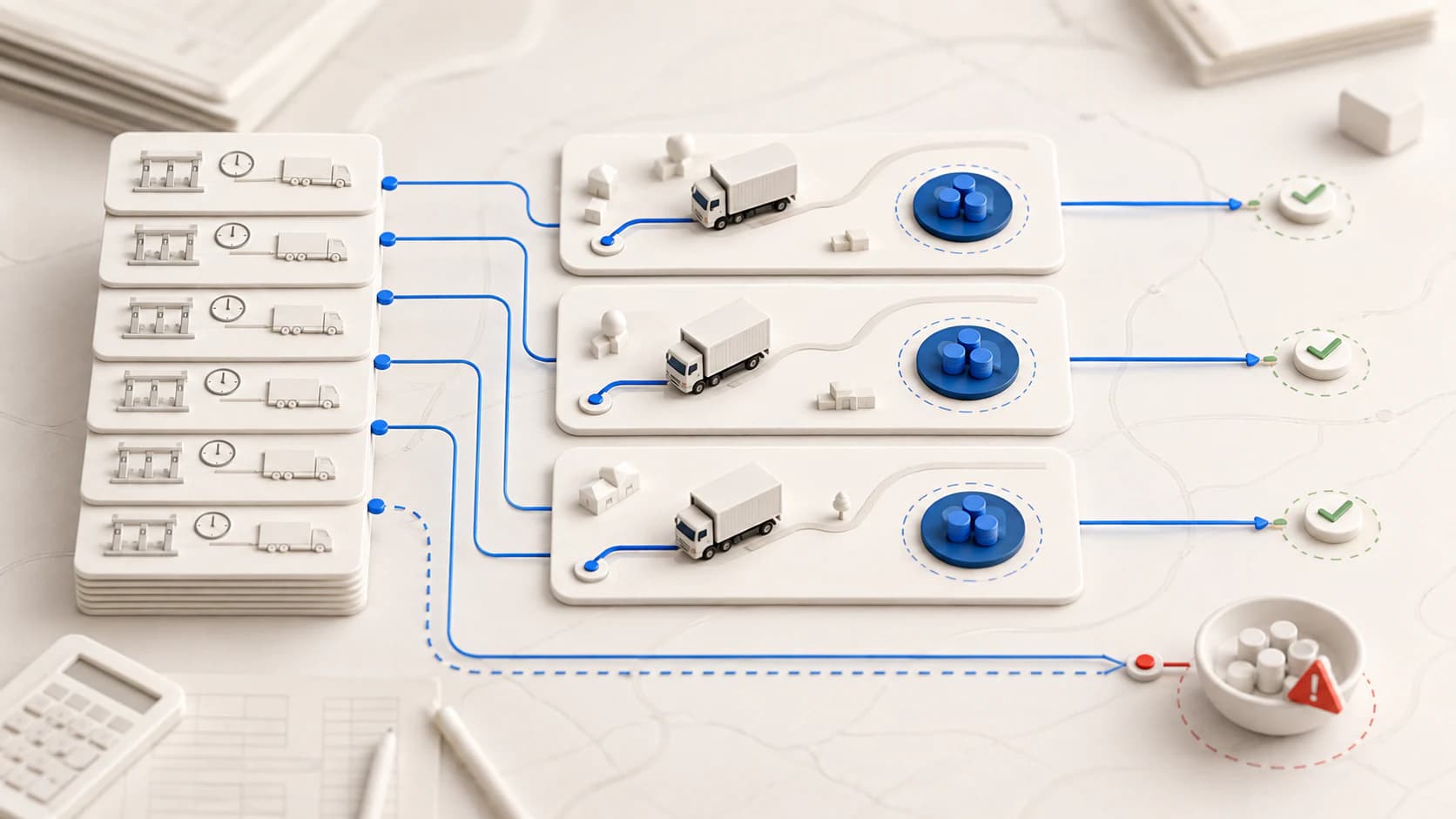
The toll statement that lands on an accountant's desk is a list of thirty or forty rows; it doesn't say which crossing belongs to which trip or which customer. Without that match, the toll expense gets booked correctly as a figure but in the wrong place — as a general expense, not a trip cost.
A toll statement covers the whole month in a single list: plate, crossing date, gate, amount. That list is accurate but incomplete — it doesn't say which crossing belongs to which trip or which customer. The statement itself can't carry that information, because the payment system knows the vehicle and the crossing, not the trip.
Someone has to make that match. When nobody does, the toll expense still gets booked — but in the wrong place: as a general monthly cost, not the cost of a specific trip.
The statement that lands on an accountant's desk is a list of thirty or forty rows. It doesn't say which crossing belongs to which trip — that information has to come from operations.
What gets lost when toll charges are lumped together?
Writing it per trip means knowing the amount first. Current bridge tariffs sit on the truck toll rates page, by vehicle class and effective date.
What's lost isn't the figure — it's which trip it belongs to. Knowing "this month's total toll expense was X" at month-end is accurate but useless; it doesn't show how much gate cost a specific route actually carried.
Profit per vehicle requires every cost line from that vehicle's trips that month to be attributed to the right trip. When tolls are booked as a general expense, a route that looks profitable may actually be carrying a high toll cost — but that stays invisible unless you look at it trip by trip.
Here's a concrete case: two vehicles running between the same two points might take different routes — one motorway-heavy, one on toll-free roads. If toll expense is split evenly as overhead, the vehicle using the motorway more looks less profitable than it really is, and the other looks more profitable — when the difference actually comes from route choice, not performance.
| Booking method | Visible at month-end | Invisible |
|---|---|---|
| One line, monthly total | The month's total toll expense | Which route carried which share |
| Trip-level, matched one by one | Each trip's real toll cost | — |
How is a toll statement matched to trip records by hand?
If you do the matching in a spreadsheet, the freight tracking Excel template keeps “Tolls” as its own cost column. Write each trip’s toll charge on its own row and the total cost and trip profit formulas cover that line too.
The method is three steps: read the crossing date and time on the statement, find which trip that plate ran that day, add the amount to that trip's cost record. It sounds simple, but the repetition is what makes it hard.
The order matters too: first the plate identifies the vehicle, then the date identifies the day, then the time identifies which trip of the day it was. Skip one of those steps — say, don't check the time — and a crossing can get booked to the wrong trip; the amount looks correct but it's attached to the wrong one's cost.
With thirty trips a month and three or four gate crossings each, that's around a hundred rows to match one by one. That work takes time and tends to land at month-end, the busiest stretch — exactly when it's most likely to get postponed.
Postponed matching usually never happens. The toll expense then settles permanently into the general expense line, and trip-level costing stays incomplete for that month.
A second factor makes matching harder: if one plate ran more than one trip the same day, which crossings belong to which trip has to be worked out from the timestamp alone. If the morning trip and the afternoon trip used the same route, drawing that line by time alone is easy to get wrong.
Subcontracted vehicles complicate it further. If a subcontractor uses their own toll tag, the charge never appears on your statement at all — it arrives as a separate line on the subcontractor's own invoice, and has to be added to the trip cost from a different source.
That means two amounts from two separate sources have to land on the same trip record; if either source gets missed, the trip cost comes out understated. Subcontractor invoices usually arrive in a batch at month-end, so this gap tends to surface weeks after the trip has closed — by which point the cost has already been reported wrong.
What's the fix at the source?
The most effective fix isn't matching the toll cost from the statement after the crossing happens — it's calculating it in advance, while the trip is still a quote. If the amount is already known per trip from the start, there's no statement left to match at month-end; you're comparing the calculated figure against the actual one, not building the match from zero.
The difference is this: with manual matching, the effort is spent after the crossing and repeats every month. With advance calculation, the effort is spent once, when the system is set up — after that, every trip produces the same calculation automatically.
Seferi Route Service runs this calculation at quoting time: every gate on the route is priced individually, and the amount is attached to the trip record from the start. We covered how the gate-by-gate calculation works in how are toll charges calculated.
Let the toll cost be attached to the trip record from the start. No statement to match at month-end.
Try it with your own lanesWhy does this matching matter to an accountant?
An accountant's job isn't just to record the figure — it's to book the expense in the right period, with the right justification. If it's unclear which trip carried which toll cost, the expense may be real but the question of which job it belongs to has no clean answer.
That ambiguity might not cause a problem on its own — but when trip-level profit reporting is requested, or a customer needs an itemised cost breakdown, having no consistent match means redoing the work from scratch. We covered what makes up a freight invoice, and where tolls sit in that chain, in how is a freight invoice issued.
The same ambiguity resurfaces under audit. If a trip's real cost is ever questioned — in a pricing dispute with a customer, for example — and there's no record showing the toll cost belonged to that specific trip, all that's left is the monthly total. A monthly total isn't enough evidence to defend a single trip.
See how toll cost gets attached to the trip record, with your own data.
Try 14 days freeFrequently asked questions
Why shouldn't toll charges be lumped into one line?
Because it hides how much toll cost each trip actually carried. Trip-level profit depends on every cost line — fuel, tolls, driver — being attributed to the right trip. If tolls are booked as a monthly general expense, which route is actually profitable and which is losing money gets blurred by that shared allocation.
How do you match a toll statement to trip records by hand?
You read the crossing date and time on the statement, find which trip that plate ran that day, and add the amount to that trip's cost record. With many trips and many crossings in a month, this matching takes time and usually gets left for later — and delayed matching often never gets done at all.
Sources and references
- Motorway and bridge toll charges — General Directorate of Highways
- Road Transport Regulation — mevzuat.gov.tr
This article is for general information; consult the relevant authority or your accountant for binding interpretation.