
Artificial intelligence
AI-powered freight software
AI here is not a slogan but a calculation running at specific steps of the operation. Below we set out what it does at each step — and what it does not.
AI turns the incoming mail into a quote
Route, load and tonnage are read from the mail; cost lines add up and your margin turns them into a price.
14 days free · no credit card
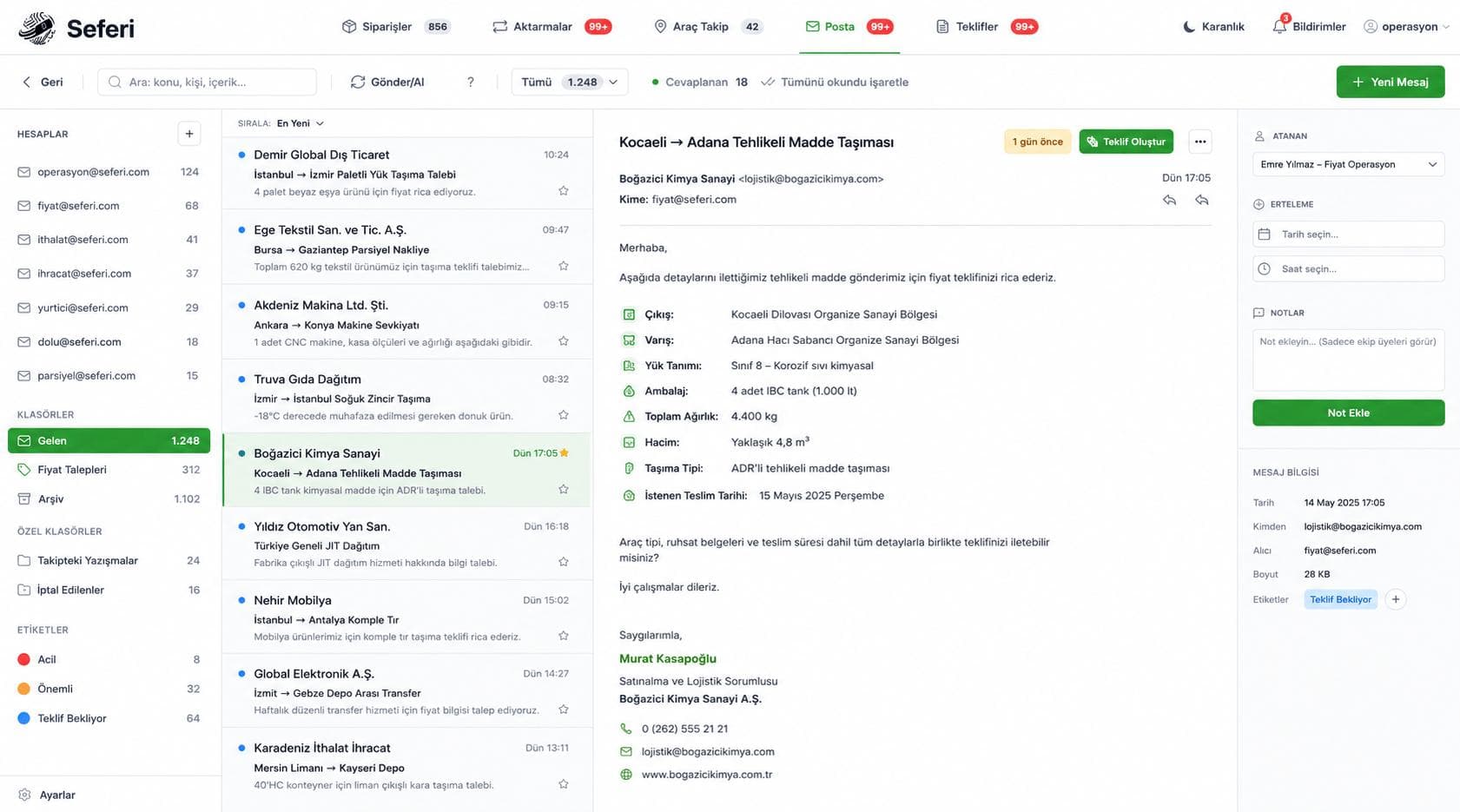
In freight software, AI is usually a cover word: what it actually does goes unsaid and savings percentages are offered instead. We do the opposite — we state which calculation runs in which module and where the decision stays with you.
AI does three jobs in Seferi: reading and structuring an incoming request, distributing work across available vehicles, and costing the route at the moment you quote. The remaining modules are automation — the two are not the same thing, and the distinction is set out below.
What runs in which module?
Read the table in two columns: on the left what the calculation does, on the right where the decision stays. The second column matters more than the first.
| Module | What the AI does | Where the decision stays |
|---|---|---|
| Seferi Posta | Reads the incoming request email and separates it into origin, destination, date, goods and vehicle count; flags the fields left missing. | You set the price. The model does not know your customer relationship, your utilisation or the odds of finding a return load. |
| Seferi Optima | Distributes the work in hand across the vehicles in hand — the kind of thirty-jobs-across-twenty-trucks calculation nobody solves in their head. | The planner approves the allocation. A driver's local knowledge or a customer's specific request is not in the model. |
| Seferi Route Engine | Calculates distance, duration and toll cost while you are still quoting, and shows where the short route and the cheap route disagree. | Which route gets used is your call; the calculation only makes the options comparable. |
| Seferi Analytics | Produces the picture of the period and surfaces the deviation that deserves attention. | What to do about it is your decision. A report shows the result, not the cause. |
What the AI does not do
This is the most important section on the page. Trusting a calculation without knowing what it cannot see is riskier than not using one at all.
- It does not set the price. Pricing is a commercial decision; risk appetite, customer history and utilisation are not in the model.
- It does not know the real waiting time at the loading bay — only an estimate, and only if it was recorded before.
- It does not know what a customer said on the phone. Nothing that was never recorded enters the calculation.
- It does not interpret regulation. U-ETDS declarations and document duties are a matter of rules, not prediction.
- It does not replace a driver's knowledge of the region or their field experience.
Are automation and AI the same thing?
No, and there is no point hiding the distinction. Automation is work whose rule is written in advance running without a hand touching it: the U-ETDS declaration going out once the trip details are entered, the timesheet falling out of the trip record, the waybill attaching to the trip. There is no prediction here, only a rule.
AI comes in where the rule cannot be written in advance: separating a freely written email into fields, finding a good allocation among the thousands of ways thirty jobs can be spread over twenty trucks, balancing cost items that pull against each other.
The value of a freight system is the sum of both. With automation alone the work gets faster but no easier; with AI alone suggestions get produced but nobody acts on them.
Read in depth
How to Prepare a Freight Quote Using AI [2026]
What AI does in a freight quote is not setting the price but turning a free-text enquiry into a structured trip request.
How Does AI Route Optimisation Work in Road Freight?
The shortest way is often the most expensive one, because route optimisation is a balance struck between distance, tolls, driving time and the delivery window.
Frequently asked questions
- What does AI-powered freight software actually mean?
- It means freight software where a model takes on the steps whose rule cannot be written in advance. In Seferi that happens in three places: turning an incoming request email into a structured trip request, distributing the work in hand across available vehicles, and costing the route at the moment of quoting. The rest of the system is automation; its rules are fixed and involve no prediction.
- Does the AI set the price by itself?
- No. The model produces the cost skeleton and you make the pricing decision. Pricing is a commercial judgement that carries your customer relationship, your utilisation that week, your odds of finding a return load and your appetite for risk. None of that is recorded in the system. A setup that leaves pricing to the model hands margin over to variables it cannot see.
- Does route optimisation just find the shortest way?
- No, and this is the most common misconception. The shortest route is often not the cheapest: a tolled motorway is short but paid for, while the toll-free route is longer, burns more fuel and takes more time. Where a delivery window exists, duration can override distance entirely. Optimisation strikes a balance between those competing goals, and the planner approves the result.
- Is the AI handling regulatory declarations too?
- No, that part is automation and it should be. U-ETDS declarations, transport waybills and invoicing duties are matters of rule: the regulation states when, with which fields and to whom the filing is made. Prediction is not wanted here; complete execution of the rule is. The declaration going out when a trip record opens is a system behaviour, not a model's decision.
- Do I need historical data before AI is useful?
- Structuring an incoming request and costing a route need no history; both work from day one. The allocation and estimation side improves with your own records: as past trips accumulate, finding a comparable job and predicting a realistic duration both get easier. History is not a precondition for starting, but the value grows with it.
See it with your own email
In Seferi an incoming price request turns into a quote in under a second — you neither read it nor price it by hand. Try it on your own inbox.
Start Free