
Invoicing & Withholding
Freight Invoicing and VAT Withholding Tracking
Only one of the nine lines on a freight invoice is decided at invoicing time — the withholding rate. The other eight simply carry forward data already entered at the quote, trip and waybill stages.
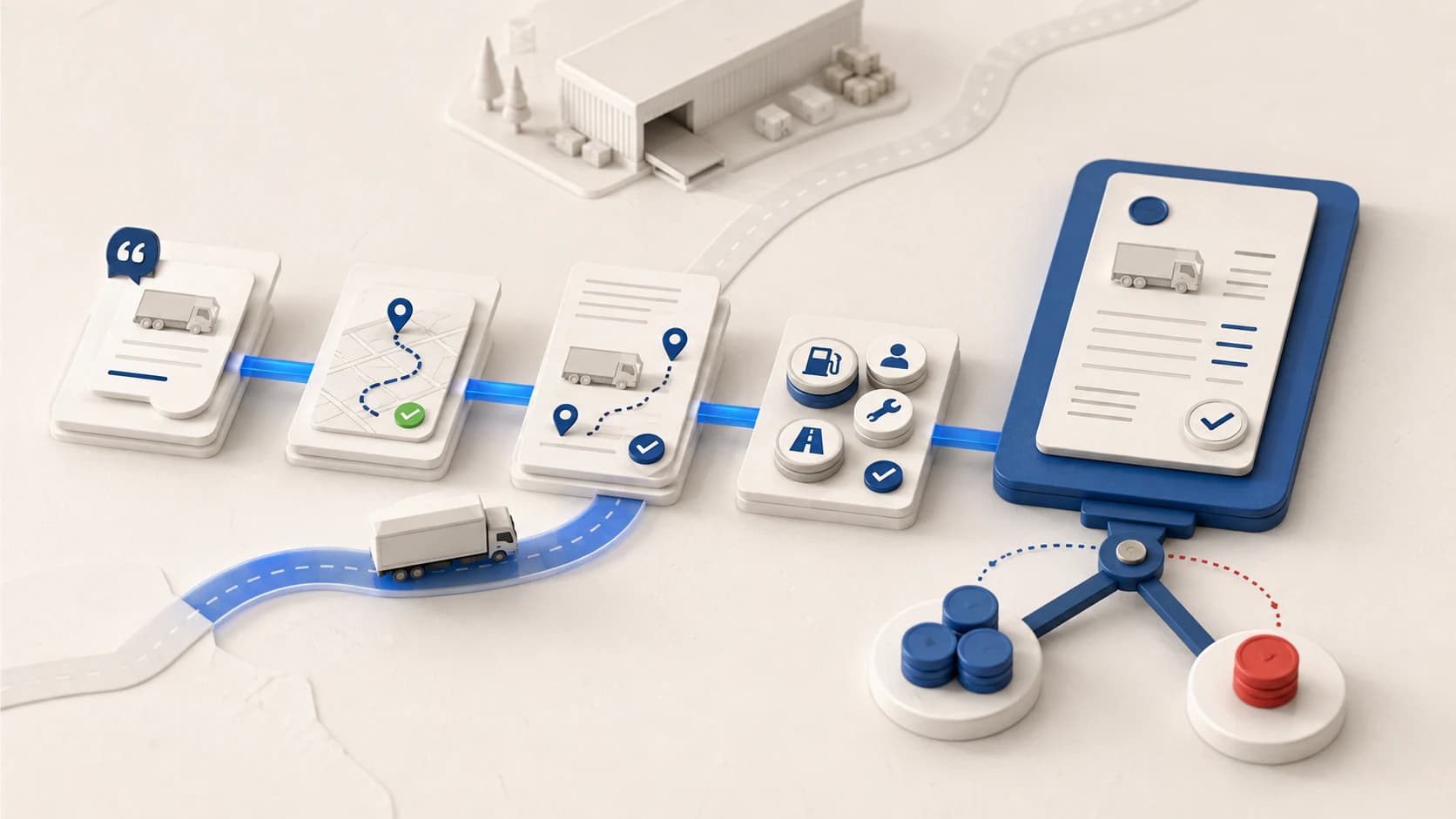
A freight invoice isn't born on the screen where it's issued. Before it, a quote was given, a trip was opened, a transport waybill was written, and a cost record was kept. The invoice is the sum of those four steps — every line in it has a precedent.
That's why most invoice errors aren't invoice errors. A wrong distance is born in the quote, a missing waybill number in the trip record, a late-entered subcontractor cost in the closing step. The invoice only makes the break in the chain visible.
Manual invoicing versus Seferi
Of nine line items, only the withholding rate is decided at invoicing time — the rest carry forward from earlier steps. The table shows where that handoff usually breaks.
| Data | Manual tracking | Tied to the trip record |
|---|---|---|
| Distance and amount | The operator writes a kilometre figure from memory, which may not match the quoted route | Carries forward unchanged from the quoted route calculation |
| Additional charges | Waiting time or a second unloading can be something the driver mentions once and nobody records | Entered from the field and tied to the trip's own record, not left for month-end recall |
| Buyer's tax status | Guessed at invoicing time | Entered on the customer record at the quote stage, read from there at invoicing |
| Withholding decision | Wrong if the tax status or rate data is wrong | Applied automatically once the tax status is correct |
What is the VAT withholding rate and limit?
The rate depends on the type of service, and the limit is updated every year. Confirm the current figure with the Revenue Administration before you act.
What this page doesn't cover
Worth drawing the line up front.
- We don't quote a fixed price or the current withholding figure here — the rate and limit change yearly; confirm with the Revenue Administration before you act.
- How the entry is booked is your accountant's call; this page explains where the invoice's data comes from, not how to book it.
- Passenger service transport (staff, student transport) isn't covered in depth here — its rate differs and deserves its own treatment.
Is invoicing a separate step, or the result of the trip record?
In most companies, the invoice is rebuilt from scratch after the trip closes: distance recalculated, extra charges recalled from memory, tax status guessed. Seferi's angle is different — the invoice is the last step of data already entered through the quote and the trip.
In practice: the quote is built the moment a request lands in the inbox, the trip opens once the quote is accepted, and the invoice is drawn from that same data once the trip closes. No second data entry.
Related articles
How to Issue a Freight Invoice: Step by Step [2026]
An invoice never arises on its own: get the quote, the trip and the transport waybill right, and the invoice comes out right.
Freight VAT Withholding (Tevkifat) Rate and Limit 2026
In freight transport the rate is 2/10, and the limit is checked on the VAT-inclusive total rather than the service fee.
Frequently asked questions
- What is the VAT withholding rate on a freight invoice?
- For goods transport, 2/10 of the calculated VAT is declared by the buyer as the responsible party, and the rest is paid to the seller. Passenger service transport (staff, students) uses a 5/10 rate — a different category, not to be confused with goods transport.
- What's the withholding limit and how is it checked?
- For 2026 the limit is 12,000 TL, checked against the VAT-inclusive total — looking only at the service fee produces errors on invoices close to the threshold. The limit is updated yearly, so confirm the current figure with the Revenue Administration before you act.
- Does withholding apply to every freight invoice?
- No. Invoices issued to individual buyers who aren't VAT taxpayers carry no withholding even above the limit; the full VAT is paid to the seller.
- Where does the invoice's data come from?
- The distance and amount entered at the quote stage, the additional-charge data from the trip record, and the tax status on the customer record combine to form the invoice. If any one of those is missing or wrong, the error is born in that earlier step, not on the invoice screen.
See it with your own invoice
The order opens the moment a quote is approved, and the invoice lines are ready when the trip closes. No step in between is carried by hand.
Start Free