

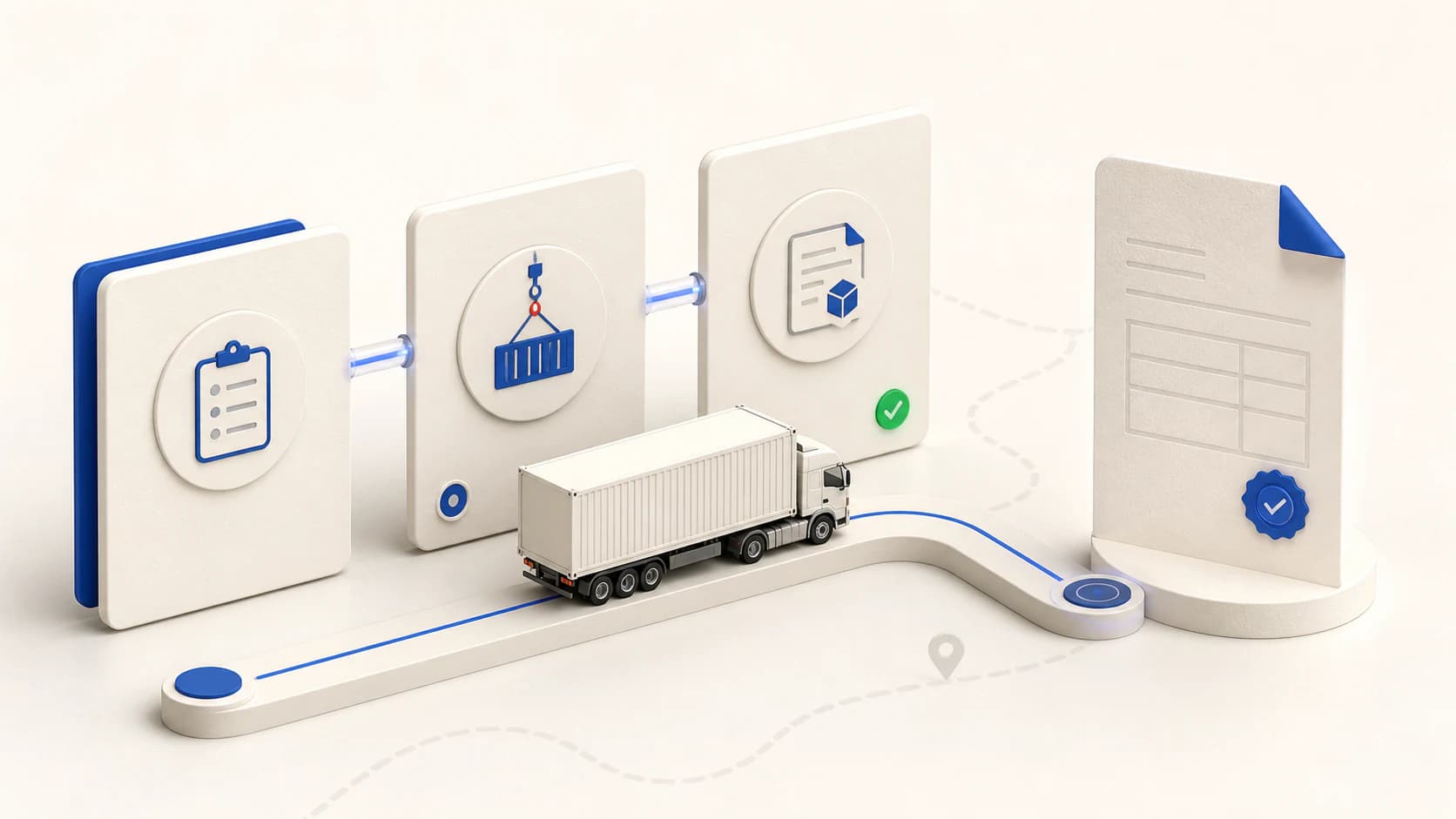
Most errors on a freight invoice are not born on the invoice screen; they are carried there from the quote, the trip and the waybill. When an invoice comes out wrong, the record that feeds it is usually the thing that needs correcting, not the invoice itself.
A freight invoice is not born on the screen where it is issued. Before it there was a quote, a trip, a transport waybill (taşıma irsaliyesi) and a cost record. The invoice is the sum of those four steps, and every line on it has an ancestor somewhere upstream.
That is why most invoicing errors are not invoicing errors at all. The wrong distance was born in the quote. The missing waybill number was born in the trip record. The subcontractor cost that lands two weeks late was born at the closing step. The invoice only makes the break in the chain visible.
For an overview of this whole chain and the withholding rates, see Freight Invoicing and VAT Withholding Tracking.
This article treats the invoice as the last link in a chain rather than a form to fill in. It follows where each piece of information comes from, how VAT withholding (tevkifat) is applied, and where the chain tends to snap in daily operations. Everything below describes practice in Türkiye, written for finance and operations people at carriers and for the accountants who work with them.
When an invoice comes out wrong, the thing that needs correcting is usually not the invoice. If the same error repeats next month, the fault sits further up the chain, and it will return every single billing period until it is fixed at its source.
When should a freight invoice be issued?
A freight invoice is issued once the transport service is complete and the trip's costs have been closed. The vehicle finishing unloading is not a sufficient signal on its own; the real test is whether every charge belonging to that trip is now known.
The difference sounds small and its consequences are not. Waiting time, a second unloading point, a route change or a port charge that surfaces afterwards usually enter the record after the truck is empty. Invoice before that and the missing amount is either never collected or has to be chased with a second document weeks later.
Defining trip closing as its own approval step is what makes this workable. Closing does not mean the vehicle finished its job; it means every revenue and cost line belonging to that trip has been recorded. Issuing invoices only from closed trips makes the incomplete invoice impossible by construction rather than by vigilance.
For customers on a periodic contract the trigger changes. There it is the close of the period, not the individual trip, that starts billing — but each trip inside the period still has to be closed in its own right. A single open trip is enough to send out a period invoice with an amount that is quietly too low.
An invoice raised before the trip closes is a problem because it is incomplete, not because it is wrong. Incomplete invoices do not look like errors and customers rarely dispute them. The loss shows up weeks later, in the margin report.
Where does every field on the invoice come from?
Almost every field on a freight invoice was entered somewhere earlier. Filling in the invoice is mostly an act of collection, not of creation. The table below shows which step of the chain each piece of information comes from and what happens when that step breaks.
| Field on the invoice | Where it comes from | What a break costs you |
|---|---|---|
| Service amount (freight rate) | The quote | Invoice differs from the agreed price, payment is delayed |
| Loading and unloading points | Trip record | Customer cannot tell which job the invoice covers |
| Distance | Route calculation in the quote | Per-kilometre pricing drifts away from the agreement |
| Service date | Trip closing | Revenue is booked to the wrong period |
| Cargo type and quantity | Quote and trip record | Tonnage-based pricing ends in a dispute |
| Waybill date and number | Transport waybill (taşıma irsaliyesi) | Invoice and movement do not match, reconciliation goes manual |
| Buyer's tax registration details | Customer record | The withholding decision is made wrongly |
| Additional service charges | Records made during the trip | The charge never reaches the invoice at all |
| Withholding rate | Definition of the service type | The shuttle rate is applied to a freight job |
Of those nine rows, exactly one is created at the moment of invoicing: the withholding rate. The other eight are information that already existed being carried forward. Time spent on the invoice screen is therefore a fairly honest measurement of how well the chain upstream was built.
Two rows break constantly in the field. The first is distance. An operator who types a number from memory instead of taking the route calculation from the quote directly corrupts the amount on any job priced per kilometre, and nobody notices until the customer's own system disagrees.
The second is additional service charges. If waiting time or a second unloading point is something the driver mentioned on the phone and nobody wrote down, it will not reach the invoice. Getting that information from the road into the record has to be attached to the flow of the trip itself, not to somebody's memory at month end.
A third row causes trouble more quietly: the buyer's tax registration details. If that was not recorded correctly on the customer record at quoting time, the withholding decision at invoicing time is made on a guess. Whether the buyer is VAT-registered is not something the person issuing the invoice should be estimating.
Let the quoted amount arrive on the invoice by itself. A request lands in the inbox and becomes a quote, an accepted quote becomes a trip, a closed trip becomes an invoice.
Try it with your own request mailsHow is VAT withholding (tevkifat) applied to a freight invoice?
Freight transport services are subject to partial VAT withholding at the rate of 2/10. In other words, 2/10 of the calculated VAT is declared by the buyer as the responsible party, and the remainder is collected by the seller in the normal way.
Shuttle transport is a separate category. Personnel and student transport services fall under a rate of 5/10. The same company may well provide both; what determines the rate is the service being invoiced, not the type of vehicle or the customer's industry. A firm that hauls cargo with a truck and carries staff with a minibus works with two different rates and must keep them apart on the invoice.
The third determinant is the amount threshold. The 2026 withholding threshold is 12,000 TL, and this check is made on the VAT-inclusive total. Below that figure, withholding is not applied.
Comparing the 12,000 TL threshold with the net, VAT-exclusive amount. An invoice that exceeds the threshold once VAT is added looks as if it sits below it when read net, and goes out with no withholding. The check must always be made on the invoice total, meaning the VAT-inclusive figure.
The fourth determinant is who the buyer is. No withholding applies on invoices issued to individual buyers who are not VAT-registered. The logic of withholding is that part of the VAT is declared by the buyer, and an individual who files no VAT return cannot do that. On work such as a household move the invoice therefore carries the full VAT.
Withholding thresholds are revised annually. The 12,000 TL figure above applies to 2026; before relying on it in a later period, confirm the current threshold with the Revenue Administration (Gelir İdaresi Başkanlığı) and with your accountant.
How these four variables — service type, rate, amount threshold and the buyer's registration status — are weighed together, and how the threshold calculation works in detail, is covered in the freight withholding threshold article. One thing should be said plainly here and only once: this is an operational view of the process, and it does not replace your accountant's judgement on tax matters.
How does the transport waybill connect to the invoice?
The document that ties the invoice to the physical movement of goods is the transport waybill (taşıma irsaliyesi), which is why carrying its date and number on the invoice is strong practice for traceability.
Who issues the document matters here. The transport waybill is issued by whoever carries goods for a fee. On paid carriage the vehicle therefore holds two documents at once: the dispatch note (sevk irsaliyesi) issued by the party sending the goods, and the transport waybill issued by the carrier. They are not substitutes for one another.
Confusion in practice usually starts precisely here. The carrier sees the customer's dispatch note, assumes the paperwork is handled and skips issuing its own transport waybill; then, at invoicing time, there is no number to reference. The difference between the two documents, and which of them has to be in the vehicle, is set out in the transport waybill versus dispatch note article.
What is lost when the number is missing from the invoice is more than a field. It becomes impossible to trace which invoice covers which trip, so reconciliation with the customer is done by comparing dates one by one — work that reliably eats hours at month end.
Which mistakes happen most often when invoicing?
The table below gathers the errors that repeat most often in the field, the consequence of each and the way to prevent it. They share one characteristic: none of them can be prevented on the invoice screen, and all of them are solved at an earlier step.
| Common mistake | Consequence | Prevention |
|---|---|---|
| Invoice issued before the trip is closed | Waiting time and extra unloading charges never reach the invoice | Make trip closing a precondition for invoicing |
| Waybill number left off the invoice | Invoice and movement do not match, reconciliation goes manual | Carry the number from the trip record to the invoice |
| 12,000 TL threshold checked on the net amount | An invoice above the threshold goes out with no withholding | Run the check on the VAT-inclusive total |
| 2/10 applied to shuttle transport | Wrong rate, correction needed after the fact | Mark the service type at quoting time |
| Withholding applied to an individual buyer | Unnecessary withholding and a customer objection | Keep registration status on the customer record |
| Subcontractor cost booked after invoicing | Trip margin changes retroactively | Enter the cost at trip closing |
| Distance written from memory | Per-kilometre pricing drifts | Take distance from the route calculation in the quote |
Six of those seven rows are solved by the shape of the workflow rather than by anyone's attention. The one exception is marking the service type, and even that is a single definition made at quoting time that every later invoice can draw from — freight at 2/10, shuttle at 5/10, decided once instead of every month.
The subcontractor cost row is the sly one. The invoice goes out with the right amount, the customer pays, everything looks settled. Then the subcontractor's own invoice arrives two weeks later, the margin on that trip changes retroactively, and a month everyone considered closed has to be recalculated.
The invoice is your operation's accuracy test. When the quote, trip, waybill and cost steps run correctly, the invoice comes out correct on its own. If you are constantly correcting things on the invoice screen, the thing that needs fixing is not the invoice but the flow feeding it.
How do you invoice a job run by a subcontractor?
A job carried by a subcontractor's vehicle produces two separate invoices, and the two must not be mixed up. You invoice your customer for the transport service; the subcontractor invoices you for theirs. Each is assessed for withholding on its own terms.
On the invoice to your customer, the fact that a subcontractor's vehicle did the work makes no difference. You are the party to the contract, you provided the service, and the invoice is issued in your name. The same logic governs the transport waybill and the U-ETDS (the Ministry of Transport's electronic freight and passenger tracking system) load declaration: the obligation follows the authorisation certificate, not the ownership of the vehicle.
The real difficulty is timing. The subcontractor's invoice usually arrives after you have already invoiced your own customer. When that lag is not tied to a recording discipline, the margin on a trip shows one figure during the month and a different one at month end.
Withholding on the invoice the subcontractor issues to you is assessed from scratch. If the service you bought is also freight transport, the same 2/10 rate and the same 12,000 TL threshold come into play for that invoice, and the threshold check is again made on the VAT-inclusive total. Because the two invoices carry different amounts, one of them may sit above the threshold while the other falls below it.
The fix is not to wait for the subcontractor's e-invoice (e-fatura). It is to record the cost at trip closing at the amount agreed, then verify it when the invoice arrives and correct any difference. Profitability is an estimate for a while, but it is an estimate available at the right time instead of a certainty available too late.
What keeps the chain from breaking?
The strength of the chain comes down to a single measure: how many times a piece of information is typed in by hand. If the same distance is written once in the quote, once in the trip record and once on the invoice, it can diverge in three places.
A sound flow runs in this order. A request arrives and a quote is prepared; amount, distance and service type are defined once, right there. When the quote is accepted a trip is opened and the quote's data moves into it. As the load leaves, the transport waybill is issued and its number is attached to the trip record. When the trip closes, costs are entered. The invoice is produced from the sum of those four steps rather than assembled from memory.
The practical test for reducing manual entry is blunt: if you are typing something for the second time, it is already recorded somewhere and it should be arriving from there. That single rule removes most of the rows in the mistake table above without anyone having to remember them. It is only enforceable, though, when the quote, the trip, the waybill and the cost record live in one freight software rather than in four places that each keep their own copy.
You can see how this flow connects end to end on the how Seferi works page. Which trips closed profitably, which closed at a loss and which records are still missing at period end is what the Seferi Reporting screen is for.
One closing caution. Everything above is written from the operational side. Final judgement on withholding, document rules and period allocation belongs to your accountant, and this article is not a substitute for that advice.
See the quote, the trip, the waybill and the invoice as one chain — so the step that breaks is visible on screen instead of in the margin report.
Try 14 days freeFrequently asked questions
When should a freight invoice be issued?
A freight invoice is issued once the transport service is complete and the trip's costs have been closed. An invoice raised before the trip is closed will not carry charges that appear late, such as waiting time, a second unloading point or a route change; when those surface you need a second invoice or a correction. The practical rule is that you invoice when the trip record closes, not when the vehicle finishes work. Under a periodic contract the trigger is the close of the period rather than the individual trip.
What is the VAT withholding rate on a freight invoice?
Freight transport services are subject to partial VAT withholding (tevkifat) at the rate of 2/10. Personnel and student shuttle transport is a separate category taxed at 5/10, and the two must not be confused even when the same company provides both. What sets the rate is the service being invoiced, not the type of vehicle or the customer's industry. Where the description of the service is open to interpretation, settle it with your accountant before the invoice goes out.
Is the withholding threshold checked before or after VAT?
The 2026 withholding threshold is 12,000 TL and it is checked on the VAT-inclusive total. The most common mistake in practice is comparing the threshold with the net figure, which makes an invoice that actually exceeds the limit look as if it falls below it, so it goes out with no withholding applied. Run the check after the invoice total is final, once every additional charge has been added. Thresholds are revised annually, so confirm the current figure with the Revenue Administration.
Does withholding apply to an invoice issued to an individual?
No, no withholding applies on invoices issued to individual buyers who are not VAT-registered. Withholding works by making the buyer declare part of the VAT as the responsible party, which only a registered taxpayer filing returns can do. On private work such as a household move the invoice therefore carries the full VAT. That is why the buyer's registration status belongs on the customer record at quoting time, not in the invoicing clerk's head.
Should the transport waybill number appear on the invoice?
Yes, carrying the transport waybill (taşıma irsaliyesi) date and number on the invoice is strong practice, because the waybill is what ties the invoice to the physical movement of goods. The transport waybill is issued by whoever carries goods for a fee, so on paid carriage the vehicle holds both the consignor's dispatch note and the carrier's transport waybill. Without the number on the invoice, nobody can later tell which invoice covers which trip and reconciliation turns into manual date matching.
Sources and references
- Revenue Administration (GİB) — VAT withholding practice
- VAT General Implementation Communiqué — mevzuat.gov.tr
- Tax withholding on freight invoices — Paraşüt
- Withholding on freight invoices — Mikro Yazılım
- How withholding works on freight invoices — İşbaşı
- Muhasebe News — current practice articles
This article is for general information; consult the relevant authority or your accountant for binding interpretation.