

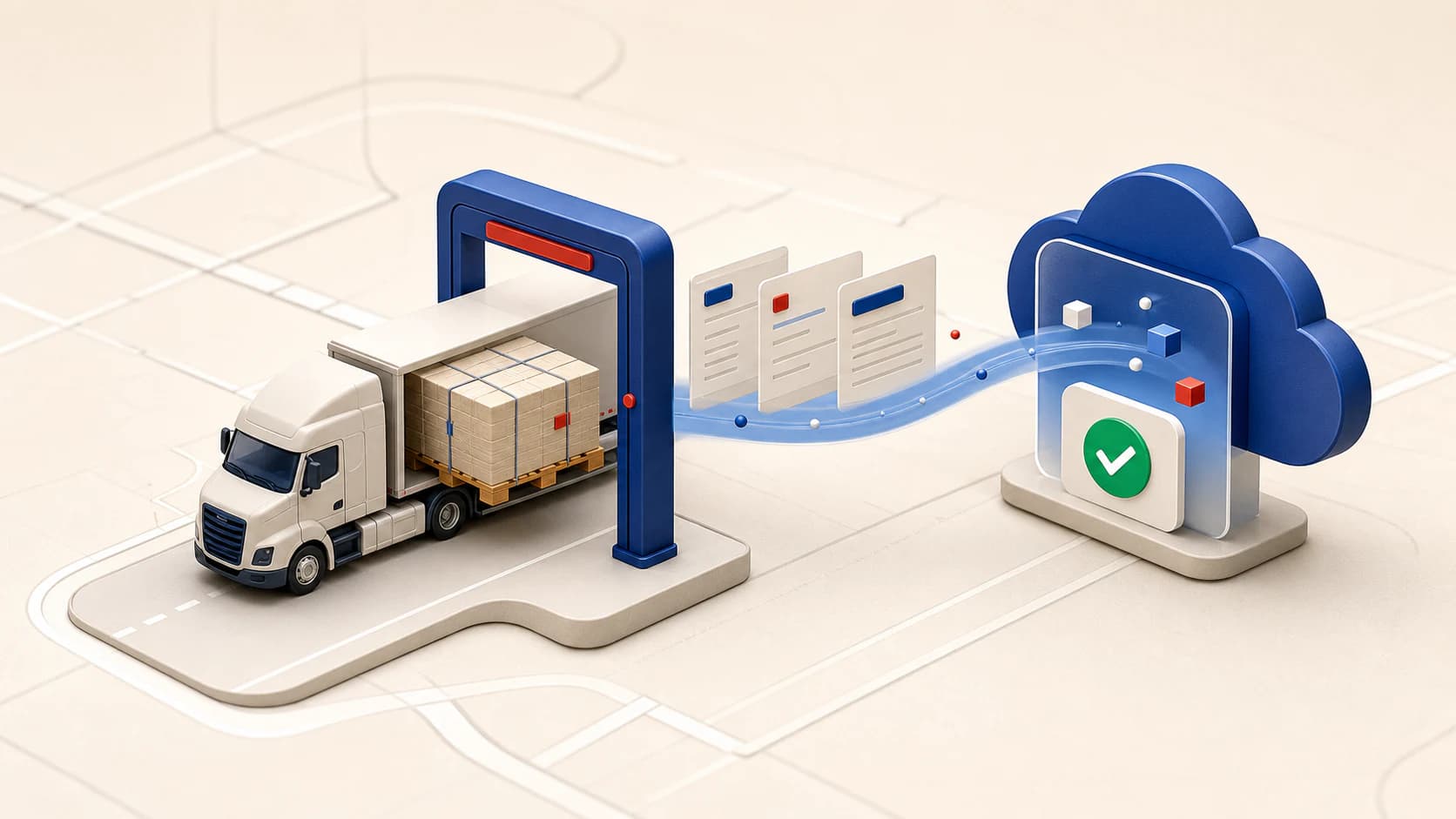
Filing the record after the vehicle has left is a widespread habit, but the regulation asks for the declaration before the carriage begins. A record opened once the trip is finished does not count as declared on time, and in any inspection carried out in between the vehicle appears unregistered.
A U-ETDS freight declaration is the record filed with the Turkish state for every load carried for hire and reward. U-ETDS (Ulaştırma Elektronik Takip ve Denetim Sistemi — the Ministry of Transport and Infrastructure's electronic tracking and inspection system) holds one entry per trip: the vehicle, the driver, the route, the two parties and the goods. The difficult part is not the filing, but entering the same information a second time, on a second screen, for every trip.
The rule fits in one sentence: the trip has to be recorded before the carriage begins. In operations it is heavier, because trip information is never held by one person — one knows the plate, another the customer details, and a third on the loading bay decides when the vehicle leaves. A declaration falls late where those pieces are waiting to meet.
For an overview of which certificates carry the filing duty and how manual filing compares to Seferi, see U-ETDS-integrated freight software.
Who has to file a U-ETDS freight declaration?
The obligation depends on the type of yetki belgesi you hold — the authorisation certificate the Ministry issues for commercial road transport. Holders of the nine certificate types below are in scope.
| Certificate | Scope | Typical holder |
|---|---|---|
| K1 | Domestic commercial goods transport | Road haulage company |
| K3 | Domestic household and office removals | Removals company |
| C2 | International and domestic goods transport | Carrier running export loads |
| C3 | International household and office removals | International removals company |
| L1 | Domestic logistics operator | Warehousing and transport together |
| L2 | International logistics operator | Cross-border logistics provider |
| N1 | Domestic freight terminal operator | Terminal consolidating part loads |
| N2 | International freight terminal operator | Cross-border freight terminal |
| R1 | Domestic freight forwarding organiser | Organiser that owns no vehicles |
If you hold one of these certificates, you open a trip record for every load you move for hire and reward. Read the table from the work rather than the codes: K1 is domestic commercial goods transport and K3 domestic household and office removals; C2 and C3 are the international counterparts of that split, C2 also covering domestic carriage. L1 and L2 are logistics operators running warehousing and transport together, at home and across borders; N1 and N2 draw the same line for freight terminal operators consolidating part loads. R1 repays the closest reading: a freight forwarding organiser has a declaration duty even owning no vehicles, and the same logic reaches a K1 holder running subcontracted trucks.
The duty follows the authorisation certificate, not the ownership of the vehicle. A trip performed under your certificate by a subcontractor's truck is declared by you. Most missing declarations start here: the routine built for the owned fleet breaks the moment a subcontracted vehicle enters it.
Businesses moving their own goods on their own vehicles sit in a different position and have to be assessed separately: the certificate class decides the answer, not the size of the fleet.
Who inside the company should file it — operations or accounting?
The declaration belongs to whoever opens the trip. It has to be filed before the carriage begins, while accounting sees the trip only at the invoicing stage — so hanging the duty on the person raising the invoice is late by design.
The pattern we meet most often: the trip is opened in operations, the paperwork travels to accounting, and whose job the declaration is has never been written down. Operations assumes accounting files it with the documents; accounting assumes operations filed it when the vehicle left.
The durable fix is to attach the responsibility to a moment rather than a person: when the declaration is part of the screen on which the trip is opened, whoever opens the trip files it with the trip.
The first question we ask a carrier is simple: who exactly files the declaration? If the answer is not one name, that company almost certainly has missing declarations. "It depends" is the polite version of "on busy days nobody does it".
When does the declaration have to be made?
The declaration must be made before the transport begins; a record entered after the vehicle has set off counts as late. In practice the trip record has to exist in the system before the truck is loaded and released.
The typical flow runs against that: loading finishes in the afternoon, the vehicle leaves at the end of the day, and the clerk enters the day's trips in one batch at closing time. An inspection falling into the gap finds a vehicle running a trip the system holds no record of.
The trip is closed in the evening and the record is entered the next morning. The record exists in the system, but not in time. When the inspection date is compared with the filing time, the trip counts as undeclared.
What makes this easy to miss is that the result looks identical in the list: at month end every trip appears recorded, because the moment each record was opened is not written next to it.
How do you file the declaration step by step?
The filing is completed in five steps, and their content is very nearly what you already enter when you open a trip in your own system.
- Open the trip record. A new record is created with the vehicle plate, the driver, the route and the date.
- Enter the parties. The consignor's and the consignee's identity or tax details and addresses are recorded.
- Describe the goods. The type and quantity of the goods being carried are entered.
- Attach the document. The related transport waybill or invoice reference is added to the record.
- Confirm and submit. Once the mandatory fields are complete, the record is confirmed and submitted to U-ETDS.
The order is not arbitrary: the trip record comes first because everything else hangs off it, and the document step is last because the waybill reference usually firms up only after loading. People get stuck at the second step — a party detail left optional on your own screen may be mandatory in the declaration.
No single step is difficult; the difficulty is writing the same plate, driver and route first into your own system and then into the Ministry portal, after which nobody can say which of the two records is right.
With Seferi the declaration goes out on its own the moment the trip details are entered. No second screen, no second data entry.
Try it with your own tripsWhere does the time actually go?
What decides the effort is not the entry screen but the gathering that comes before it: the plate, the driver, the customer record and the waybill number all sit in different places. The table below shows where a single declaration stalls.
| Step | Where the time goes | Source of the loss |
|---|---|---|
| Logging into the portal | Signing in and reaching the right screen | The declaration lives in a separate system |
| Finding the trip details | Reading plate, driver and route off another screen | The details are not held with the trip |
| Entering the parties | Copying customer record details by hand | The same data sits in two systems |
| Goods and document details | Looking up the waybill number in the paperwork | The document is not attached to the trip record |
| Submission and response | Noticing a rejection and correcting it | The response is not stored anywhere |
| Repetition | Doing the same work again for every trip | The loss grows with the number of trips |
Put the rows into plain sentences: logging into the portal costs time because the declaration lives in a separate system; finding the trip details costs time because the plate, driver and route are not held with the trip; entering the parties costs time because the customer record sits in two systems and has to be copied across by hand.
Goods and document details cost time because the waybill number is not attached to the trip record and has to be hunted from the paperwork; submission costs time because the rejection message is stored nowhere and has to be spotted while somebody is watching. The last row differs in kind: the first five are a one-off nuisance, while repeating the work for every trip is what turns the declaration into a daily job.
The time is not lost because the screen is slow. It is lost because the information is scattered. In a flow that reads the same data from a single record, most of the steps are already done and only the submission remains.
What is the difference between manual e-Devlet entry and web service integration?
The Ministry permits integration over a web service between a carrier's own transport management system and U-ETDS. Once the connection is in place, the trip details you enter into your own system are submitted without the e-Devlet state portal ever being opened.
| Criterion | Manual e-Devlet entry | Web service integration |
|---|---|---|
| Source of data | Two separate records | One record: the trip itself |
| Moment of filing | Whenever the operator gets to it | The moment the details are entered |
| Risk of inconsistency | High — the two records can drift apart | None — there is a single source |
| Rejection response | Missed unless someone is watching the portal | Lands on the trip screen |
| Subcontracted vehicles | Frequently skipped | Run through the same flow |
| Behaviour on busy days | Piles up and slips to the next day | Unaffected by volume |
Read straight down: manual entry keeps the data in two records and files whenever the operator gets to it, while an integration has a single source — the trip itself — and files as the trip is opened. Inconsistency risk is high when two records can drift apart and absent with one source; a rejection is missed unless somebody watches the portal, but lands on the trip screen in an integration. Subcontracted vehicles are frequently skipped in manual entry yet run through the same flow in an integration, and on a busy day manual entry piles up and slips to the next day while an integration is unaffected by volume.
The most consequential of those rows is the rejection response. A record rejected during manual filing stays invisible unless somebody happens to be looking at the portal: the carrier believes the declaration was made, the system holds nothing, and a rejected record counts as not notified. We covered how to catch it in U-ETDS record rejected.
Which route suits you depends less on fleet size than on how much your volume swings: a single vehicle running a few trips a week manages with manual entry, but once subcontracted vehicles carry a meaningful share of the work, or volume swings seasonally, a separately maintained routine breaks — and it breaks at the peak. The how Seferi works page follows the whole flow, and the features page shows which module covers which step.
What happens if a trip is cancelled or the route changes?
When a declared trip is cancelled or its route changes, the record is updated rather than left as it stands: the declaration has to reflect the carriage as it actually happened. A vehicle that never left showing as on the road makes the filing untrue.
This happens far more often than people assume: the customer postpones loading, the vehicle breaks down, the driver is swapped. The change then stops at your own trip screen — operations updates the route or marks the trip cancelled, and nothing happens on the declaration side, where the update is a separate job for a separate person.
The change has to travel through the trip record as well: cancelling the trip cancels the declaration, and a change of route or driver goes out from the same record. Where that is a separate task, even a correct original filing drifts away from reality.
A cancelled trip goes on standing in the system as a live carriage until its declaration is cancelled too. This is the mirror image of a missing declaration and it is harder to spot: nothing looks absent in the list, so nobody goes looking.
Is the declaration the same as a transport waybill?
No — they are separate obligations and neither substitutes for the other. The U-ETDS declaration is an electronic record; the taşıma irsaliyesi, or transport waybill, is a document that must be physically present in the vehicle. At an inspection both are asked for separately.
They are complements, not backups: having filed the declaration does not make carriage without a waybill lawful, and having issued the waybill does not discharge the duty to declare.
The distinction is clean on paper and muddled in the field: which of the transport waybill and the dispatch note applies, and who issues which, comes up constantly. We set out the difference in transport waybill versus dispatch note.
What happens if you do not file?
The sanction is not primarily a fine but warning points accumulating against your authorisation certificate. A warning is recorded for each undeclared trip, and a deliberately false declaration is treated considerably more severely. Carriers that close their periods completely have points removed from that balance.
A three-month period closed completely, on time and error-free removes part of the warning balance. The three conditions apply together: no undeclared trip may remain, every filing must precede its carriage, and no record may have been rejected. A single silent rejection, counting as not notified, breaks two of them at once.
Consistent filing therefore does more than reduce penalty exposure: every cleanly closed period erodes the warning burden carried from the past, while one missing or rejected record removes that benefit for the whole period.
Fine amounts and warning point thresholds are revalued every year, so we quote no figures here — verify them from the Ministry source before acting. We covered how the sanction mechanism works in how much is the U-ETDS penalty. Exposure comes not from skipping a single trip, but from running the declaration separately from the operation.
One clarification worth making, because the two get mixed up: filing the declaration from the trip record is automation, not artificial intelligence. Nothing is being predicted — the same fields simply move once instead of twice, which is all a freight software needs to do here. Where judgement genuinely enters, in planning and pricing, is a separate subject, taken up on the AI-powered freight software page.
Try it on your own trips — see on one screen what it means for the declaration to come out of the operation itself.
Try 14 days freeFrequently asked questions
Who has to file the U-ETDS freight declaration?
Companies holding a K1, K3, C2, C3, L1, L2, N1, N2 or R1 authorisation certificate are required to file freight declarations. The duty follows the authorisation certificate, not the ownership of the vehicle: whether the carriage runs on your own truck or a subcontracted one, if the certificate is in your name the declaration is your responsibility. Businesses moving their own goods on their own vehicles are in a different position, and that has to be checked separately against the certificate type.
When does the declaration have to be made?
The declaration must be made before the transport begins. A record entered after the vehicle has set off counts as late. In practice that means the trip record has to exist in the system before the truck is loaded and released. This is the single most common failure in day-to-day operations: the trip is closed in the evening, the record is entered the following morning, and an inspection in between finds no declaration for that vehicle.
Can the declaration be filed without logging into e-Devlet?
Yes. The Ministry of Transport and Infrastructure permits integration over a web service. Once a connection is established between the carrier's own transport management system and the Ministry's system, the trip details entered into that system are submitted automatically without the e-Devlet state portal ever being opened. This removes the need to key the same data twice and the inconsistencies that come from doing so.
Do I have to declare a trip run by a subcontracted vehicle?
Yes. The obligation attaches to the authorisation certificate, not to who owns the truck. A trip performed under your certificate by a subcontractor's vehicle has to be declared by you. Because a large share of the vehicles in most fleets belongs to third parties, this is the point most often missed in practice: the routine built for the owned fleet breaks when a subcontracted vehicle enters it, and that is where most missing declarations come from.
Does the declaration replace the transport waybill?
No. The U-ETDS record is an electronic filing, while the transport waybill is a document that has to be physically present in the vehicle. Neither one substitutes for the other and both are asked for separately at an inspection. Having filed the declaration does not make carriage without a waybill lawful, and having issued the waybill does not discharge your duty to declare.
Sources and references
- U-ETDS — official portal of the Ministry of Transport and Infrastructure (Ulaştırma ve Altyapı Bakanlığı)
- Road Transport Regulation (Karayolu Taşıma Yönetmeliği) — mevzuat.gov.tr
- U-ETDS freight declaration — who files, and when
- U-ETDS web service integration — MDP Group
- U-ETDS penalties and the warning point system
- Legal commentary on U-ETDS — Tüfekçi Law
This article is for general information; consult the relevant authority or your accountant for binding interpretation.