

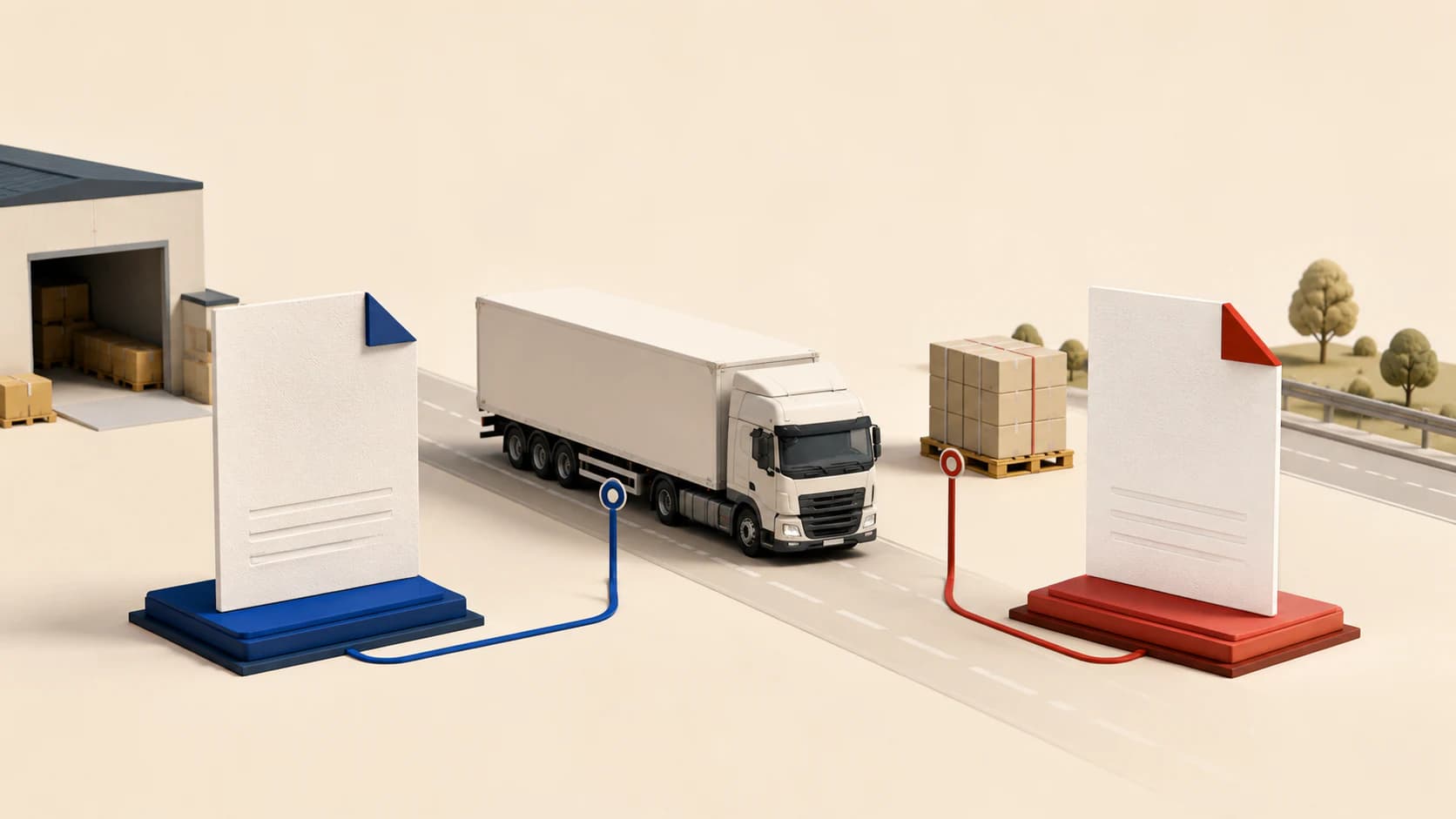
The two documents are not alternatives to each other, they are complements: the dispatch note shows who the goods belong to, the transport waybill shows who moved them. On a load carried for a fee, holding only one of them means leaving the yard a document short.
These are the two documents that get confused most often on the ground in Türkiye. Both are called irsaliye in Turkish, both travel with the goods, and both are asked for at a roadside check.
Despite that, they are issued by different parties and they answer completely different questions. This article works through who issues which document, when both of them have to be in the vehicle, and where a U-ETDS notification sits in that picture.
If you run freight in Türkiye but did not grow up with the Turkish document regime, this is the distinction that costs the most to learn the hard way.
The dispatch note follows the goods, the transport waybill follows the carriage. One answers "who owns these goods and where are they going", the other answers "who is moving this load, and in which vehicle". Two separate questions, so one shipment can need two separate documents.
What is the difference between a transport waybill and a dispatch note?
The difference is who issues the document and what the document proves. The dispatch note (sevk irsaliyesi) is issued by the seller of the goods, or by a buyer who collects the goods themselves.
The transport waybill (taşıma irsaliyesi) is issued by whoever carries the goods for a fee. The contents of each document follow directly from that split, which is why the two look similar on a desk but are not interchangeable.
| Criterion | Dispatch note (sevk irsaliyesi) | Transport waybill (taşıma irsaliyesi) |
|---|---|---|
| Who issues it | The seller, or a buyer who collects the goods themselves | Whoever carries the goods for a fee |
| What it tracks | The movement of the goods | The carriage service itself |
| Question it answers | Who owns the goods, and from where to where are they moving | Who is carrying the load, and in which vehicle |
| Leading detail | Consignor and consignee, type and quantity of goods | Vehicle plate, carrier, driver, route |
| Own goods in own vehicle | Required | Not required |
| Goods carried for a fee | Required | Required |
It is worth restating the rows in plain prose, because this is exactly where the distinction becomes usable. The dispatch note is issued by the seller, or by a buyer who collects the goods themselves, and it tracks the movement of the goods: where they left, who they are going to, what they are and how many.
The transport waybill is issued by whoever carries the goods for a fee, and it shows the carriage itself: which vehicle, on whose behalf, along which route.
If you move your own goods in your own vehicle, no transport waybill is needed and the dispatch note is sufficient. If the goods are carried for a fee, both are required.
That content difference is the source of the confusion. The two documents look at the same shipment but grab it from different sides: one records who owns the goods, the other records who moved them.
Because they sit next to each other in the same folder, people assume they are two copies of one obligation. They are not, and if one is missing the other does not cover for it.
What decides who issues a document is not who owns the goods but whether the carriage is being performed for a fee.
Who issues the transport waybill (taşıma irsaliyesi)?
The transport waybill is issued by whoever carries the goods for a fee. The responsible party is not the owner of the goods but the carrier who is being paid to move them. Who the load belongs to, who will raise the invoice and where the goods are heading do not shift that responsibility anywhere else.
The single deciding criterion is whether the carriage is performed for a fee. If a party is being paid to move that load, that party issues the transport waybill. If no party is being paid, the transport waybill never enters the picture.
That one sentence also explains the most frequent mistake in the yard. Companies look for the transport waybill obligation on the owner of the goods, but the owner is responsible for the dispatch note. The transport waybill is the carrier's own document, and the carrier is also the party who has to produce it at the moment of loading, not afterwards from the office.
When you are unsure, ask this: is anyone being paid to move this load? If the answer is yes, that party issues the transport waybill. If the answer is no, no transport waybill is required, but the dispatch note is still required.
The same fee-or-no-fee logic runs through the wider Turkish transport regime. Carrying goods commercially in Türkiye is tied to an authorisation certificate (yetki belgesi) from the Ministry of Transport and Infrastructure, whose classes carry codes such as K1, K3, C2, C3, L1, L2, N1, N2 and R1.
Which class applies to you is a separate matter, settled by your own certificate and the Ministry rather than by the document rules discussed here.
Who issues the dispatch note (sevk irsaliyesi)?
The dispatch note is issued by the seller of the goods, or by a buyer who collects the goods themselves. Its purpose is to track the movement of the goods: which business they left, which address they are going to, what they are and how many. If goods move, that movement has to be documented.
There are two possible issuers because the goods can set off on either party's initiative. If the seller sends the goods to the buyer, the seller issues the dispatch note.
If the buyer collects the goods from the seller using their own means, the buyer issues it. In both cases the document travels with the goods rather than following in the post.
The document does not have to be attached to a sale at all. Even when nothing is sold and the goods simply move from one warehouse of the same business to another, they are moving, and that movement is expected to be documented.
What triggers a dispatch note is the movement of goods, not the sale of them. This is the point that catches out foreign operators most often, because in several other jurisdictions an internal stock transfer generates nothing but an internal record.
Equally, the dispatch note makes no claim about the carriage. It is not designed to show who owns the vehicle or whether the movement was paid for. It records who the goods went from and to, and nothing more, which is precisely why it cannot stand alone on a load carried for a fee.
Which documents must be in the vehicle?
When goods are carried for a fee, both the dispatch note and the transport waybill must be present in the vehicle. Because the two documents prove two different facts, neither one substitutes for the other. The matrix below shows who issues what in the situations that come up most often.
| Situation | Dispatch note | Transport waybill | Who issues |
|---|---|---|---|
| Seller delivers the goods to the buyer in its own vehicle | Required | Not required | Seller |
| Buyer collects the goods from the seller using its own means | Required | Not required | Buyer |
| A carrier moves the load for a fee | Required | Required | Dispatch note: seller or buyer — Waybill: the carrier |
| A company moves its own goods to its own branch in its own vehicle | Required | Not required | The company |
| A company hands its own goods to a carrier for delivery to its branch | Required | Required | Dispatch note: the company — Waybill: the carrier |
| One vehicle carries loads from several consignors | One per consignment | Required | Dispatch note: each consignor for its own goods — Waybill: the party performing the carriage |
Here is the matrix in prose. If the seller delivers the goods to the buyer in its own vehicle, the seller issues the dispatch note and no transport waybill is needed.
If the buyer collects the goods from the seller using its own means, the buyer issues the dispatch note and again no transport waybill is needed. If a carrier moves the load for a fee, both documents are required: the dispatch note comes from the seller or the buyer, the transport waybill from the carrier.
If a company moves its own goods to its own branch in its own vehicle, it issues a dispatch note and needs no transport waybill.
Hand those same goods to a carrier and the picture changes: both are required, the dispatch note from the company and the transport waybill from the carrier. Where one vehicle carries loads from several consignors, each consignment travels with its own dispatch note, while the transport waybill is issued by the party performing the carriage for a fee.
The document that goes missing in practice is almost always the transport waybill. The dispatch note is already at the loading point, because the goods are not loaded without it. The transport waybill is the carrier's own document, and on a busy loading day it is the easiest step in the whole sequence to skip.
At a check, those two questions are asked separately: who do the goods in this vehicle belong to, and who is carrying this load. The first answer is on the dispatch note, the second on the transport waybill.
So "we have the paperwork" is not an answer on its own. What matters is which piece of paperwork answers which question.
What if I carry my own goods in my own vehicle?
If you carry your own goods in your own vehicle, no transport waybill is required and the dispatch note is sufficient. The logic is simple: the transport waybill is issued by whoever carries goods for a fee, and here no carriage service has been sold. You are not selling a haulage service to yourself, so there is no transport waybill for you to issue.
The dispatch note obligation, though, continues exactly as before. If goods move from one place to another, that movement has to be documented, and your own warehouse-to-branch transfer falls inside that. Using your own vehicle is not a reason to move goods with no document at all.
The thing to watch here is that one fleet often lives in both situations.
A company that moves its own goods in its own vehicle today falls under the transport waybill obligation tomorrow, the moment it carries someone else's freight for a fee. So the rule is not configured once according to who owns the vehicle; it is assessed separately for every trip.
Mixed fleets, own-account distribution in the morning and paid backhauls in the afternoon, are where this goes wrong most often, and the answer is to record the paid-or-not decision as part of opening the trip rather than leaving it to the driver.
The document should be an output of the trip record, not a separate act of remembering. If the vehicle, the driver and the route are already entered, the document can come from that same data.
Try it with your own tripsDoes a U-ETDS notification replace the waybill?
How the filing side runs is set out on our U-ETDS page: which filing is made when, and why the trip record and the filing need to sit in the same place.
No, a U-ETDS notification does not replace the waybill. A U-ETDS notification is an electronic record: the details of the trip are transmitted to the Ministry of Transport and Infrastructure system.
The waybill is a physical document that has to be in the vehicle. They are separate obligations and neither covers a gap in the other.
They are also checked separately. Filing the notification on time does not legitimise carrying goods without the required document, and issuing complete documents does not remove your notification duty. We walk through when and how the notification is filed in how to file a U-ETDS cargo notification.
"I filed the notification, the record is in the system" does not close a document gap. Equally, "my waybills are complete" does not remove the notification duty.
The penalty for carrying goods without the required document is a separate subject, covered in transport waybill penalties. Amounts are revalued every year, so confirm the current figure from the Revenue Administration.
One reason these two obligations get mixed up is that they carry the same data. Plate, driver, consignor, consignee and cargo detail appear in both the notification and the document. An operation that has to key the same information into two places will, sooner or later, start treating one of them as sufficient.
Where does this distinction break down in operations?
The breaking point is not a lack of knowledge, it is that the document is produced outside the flow of the operation. Even a dispatcher who knows the distinction perfectly will skip the transport waybill when loading volume spikes, because if the document is produced on a separate screen, at a separate moment, by a separate person's memory, the error arrives eventually.
Three scenarios recur. The first is treating the dispatch note as enough: the consignor prepares it, the carrier says the paperwork is done, and the vehicle leaves a document short.
The second is carrying an own-account habit into paid haulage: a fleet that spent years moving its own goods keeps the old routine when it starts carrying for a fee. The third is the same data entered differently in different places: the plate on the document and the plate in the notification diverge, and nobody can say which one is correct.
All three have the same remedy. The trip is opened once; vehicle, driver, consignor, consignee and cargo go into a single record.
Both the notification and the document are derived from that record. The duplication disappears, and so does the possibility of the two records drifting apart.
You can see how that flow is built end to end on the how Seferi works page, and which module handles which step on the features page. That is all a freight software is doing when it produces the waybill from the trip record: not replacing the document, only stopping it being typed a second time.
The last link in the document chain is the invoice. Documents evidence the movement of the goods and of the carriage; the invoice evidences the price of the service.
When the two are not tied together, month-end reconciliation drags. We cover how a haulage invoice is tied back to the documents in how to issue a freight invoice.
A closing warning: moving documents into electronic form does not remove this distinction. Whether a document is paper or electronic does not change who has to issue it.
The dispatch note still belongs to the party selling or collecting the goods, and the transport waybill still belongs to the party carrying them for a fee. The scope and mandatory thresholds of the e-document regime are updated from time to time, so confirm your own position from an official source or with your accountant.
Try it on your own trips — see on one screen what it means for the document and the notification to come out of a single record.
Try 14 days freeFrequently asked questions
Are the transport waybill and the dispatch note the same document?
No, they are two separate documents, issued by different parties and answering different questions. The dispatch note (sevk irsaliyesi) is issued by the seller of the goods, or by a buyer who collects the goods themselves. The transport waybill (taşıma irsaliyesi) is issued by whoever carries the goods for a fee. Their contents follow that split. The dispatch note tracks the movement of the goods: where they left from, who they are going to, what they are and how many. The transport waybill shows the carriage itself: which vehicle is moving the load, which company took on the job, who is driving, along what route. Because both are called irsaliye in Turkish and both travel alongside the goods, they get mixed up constantly in the yard. The practical consequence of that confusion is always the same: a company treats the dispatch note as enough and skips the transport waybill that a paid movement also requires. The reliable way to think about it is that the dispatch note follows the goods and the transport waybill follows the carriage. One shipment raises two different questions, so it can need two different documents. Moving the paperwork into electronic form does not change that split either, because who has to issue what is still decided the same way.
Who issues the transport waybill?
The transport waybill is issued by whoever carries the goods for a fee. The party on the hook is not the owner of the goods but the carrier who is being paid to move them. That single sentence settles most of the arguments that happen at a loading bay: who owns the load, who will raise the invoice and where the goods are heading do not change who is responsible for the transport waybill. The only thing that decides it is whether the carriage is being performed for a fee. The consequence follows directly. If a person or company moves its own goods in its own vehicle, no carriage service is being sold, so no transport waybill is needed and the dispatch note is sufficient. Hand the same goods to a carrier, however, and the obligation appears immediately. The most common operational mistake is to look for the transport waybill obligation on the owner of the goods. The owner is responsible for the dispatch note; the transport waybill belongs to the party doing the carrying. When you are unsure, ask one question: is anyone being paid to move this load? If yes, that party issues the transport waybill. If no, no transport waybill is required, but the dispatch note obligation still stands. Apply the test trip by trip, because the same fleet can move its own goods one day and someone else's freight for a fee the next.
Must both the dispatch note and the transport waybill be in the vehicle?
Yes, when goods are carried for a fee both documents must be present in the vehicle. They are both required because they prove two different things. The dispatch note shows who the goods in the vehicle belong to and where they are going; the transport waybill shows which vehicle is moving them and on whose behalf. At a roadside check those two questions are asked separately, and the answer to one does not stand in for the answer to the other. In practice, the one that goes missing is almost always the transport waybill. The dispatch note is already prepared at the loading point, because the consignor prepares it and the goods are not loaded without it. The transport waybill is the carrier's own document, and on a busy loading day that is the easiest step to skip. The vehicle leaves, the folder holds only the dispatch note, and the gap is discovered on the road. The practical fix is to make the transport waybill an output of the trip record rather than a separate act of remembering. The vehicle, the driver and the route are already entered when the trip is opened, so the document can be produced from that same data instead of depending on somebody recalling it during the busiest hour of the day.
Do I need a transport waybill for my own goods in my own vehicle?
No, if you carry your own goods in your own vehicle you do not need a transport waybill; the dispatch note is sufficient. The reasoning is simple. The transport waybill is issued by whoever carries goods for a fee, and when you move your own goods there is no carriage service being sold. You are not selling a haulage service to yourself, so there is no transport waybill for you to issue. The dispatch note obligation, however, does not disappear. If goods move from one place to another, that movement has to be documented, and that duty sits with the seller of the goods or with a buyer who collects them personally. A transfer from your own warehouse to your own branch falls squarely inside this. The point to watch is that the same fleet often lives in both worlds. A company that moves its own goods in its own vehicle today takes on the transport waybill obligation tomorrow, the moment it carries someone else's freight for a fee. So the rule is not set once according to who owns the vehicle; it is assessed trip by trip, according to whether that particular movement is being performed for a fee. For businesses that use one fleet for both their own distribution and paid haulage, the cleanest method is to mark at trip creation whether the movement is paid, and derive the required documents from that flag rather than from a dispatcher's judgement in the moment.
I filed a U-ETDS notification, can I skip the waybill?
No, a U-ETDS notification does not replace the waybill. A U-ETDS notification is an electronic record: details of the trip are transmitted to the Ministry of Transport and Infrastructure system. The waybill is a physical document that has to be present in the vehicle, and it comes from tax legislation. They are two different obligations, requested by different authorities for different purposes, and neither one covers a gap in the other. They are checked separately as well. Filing the notification on time does not make an undocumented movement lawful, and issuing a complete waybill does not remove your notification duty. The reason the two get confused in the field is that they carry the same data: plate, driver, consignor, consignee and cargo detail appear in both. An operation forced to key the same information twice naturally starts treating one of them as sufficient. The right response is to derive both from a single trip record. Open the trip once, and both the notification and the document come out of the same source, which removes the duplication and stops the two records drifting apart. Without that discipline, the most common outcome is that the plate on the waybill and the plate in the notification no longer match, and nobody can say which one is authoritative when it is questioned. Penalties for carrying goods without the required document are a separate subject, and because the amounts are revalued every year the current figure has to be confirmed from the Revenue Administration.
Sources and references
- Tax Procedure Law — mevzuat.gov.tr
- Revenue Administration — document rules
- Are the dispatch note and transport waybill different documents? — MuhasebeNews
- What the dispatch note is and how it is issued — Paraşüt
- e-Document applications — Revenue Administration e-Belge portal
- Ministry of Trade — commercial documents and regulatory notices
This article is for general information; consult the relevant authority or your accountant for binding interpretation.