

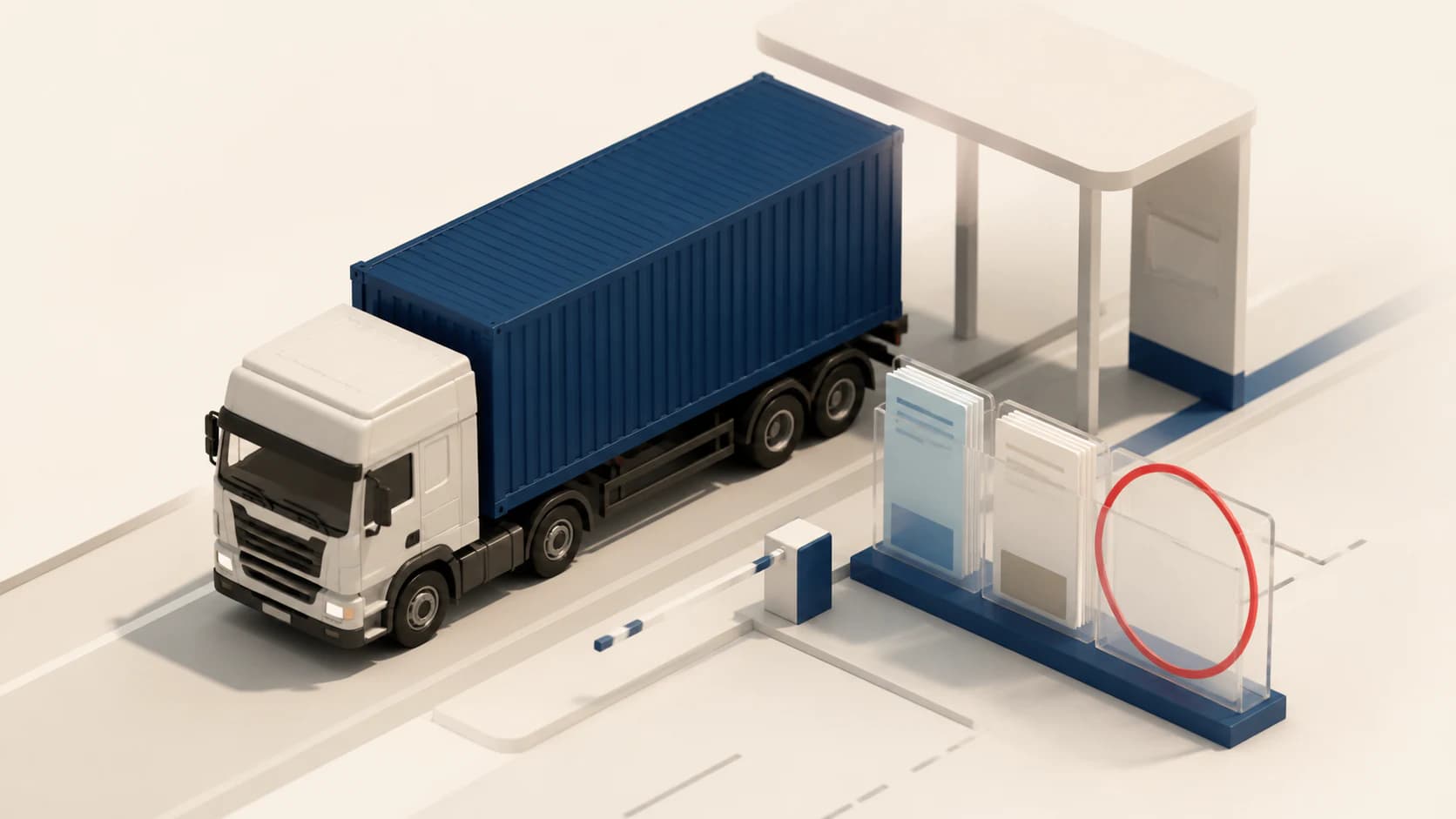
The most common mistake here is assuming the penalty lands on the company that sent the goods. The transport waybill belongs to whoever carries goods for a fee; if you did not issue your own document, your customer's dispatch note will not protect you.
The sanction for not issuing a transport waybill (taşıma irsaliyesi) is a special irregularity penalty under the Tax Procedure Law (Vergi Usul Kanunu). It is written against the party that carries the goods for a fee, not against the party that sent them. This is exactly where the most expensive misunderstanding in road freight begins.
The sentence we hear most often on site is this: the customer gave us the paperwork, there is a document in the cab. But what the customer hands over is the dispatch note (sevk irsaliyesi), and the party responsible for it is whoever sells or collects the goods. Your document is a separate one, and nobody issues it on your behalf.
This article covers which gap produces which consequence, why no penalty figure appears anywhere in it, why a U-ETDS filing — the electronic trip notification made to the Ministry of Transport and Infrastructure — does not stand in for the waybill, and which company profiles carry the concentrated risk.
What happens if the transport waybill is not issued?
When the document is missing, a special irregularity penalty arises under the Tax Procedure Law, and it applies separately for every document that was not issued. That means the gap is not settled as one line item: if several trips on a single inspection day are undocumented, the outcome grows in the same proportion.
Gaps surface in two ways. The first is the roadside check: the vehicle is stopped and the documents on board are compared with the load actually being carried.
The second is a records-based examination, in which the issued document series is reconciled against invoices and trip records. The second route is less familiar to operators, but because it covers a much longer period the result is usually heavier.
A further point is that the gap rarely arrives alone. When undocumented carriage is found on the road, road transport legislation sanctions can run for the same trip as well. The tax-side penalty and the transport-side sanction do not cancel each other out; they run in parallel and are assessed by different authorities.
Whether the document was written on a printed pad or produced electronically does not change the obligation. Taxpayers inside the e-document scope create and store it electronically, and those outside it continue with printed pads.
What is looked for is identical in both cases: that the document was issued during the carriage and can be presented on request. Moving to an electronic document does not close the gap by itself — it only makes the gap far easier to trace after the fact.
Missing paperwork usually comes from ordinary timing, not from ignorance. The pad is in the office, the vehicle is on the road.
The trip leaves in the morning, the document is written in the evening. If an inspection happens in between, the paper written at night does not rescue the trip made at dawn.
Who issues the transport waybill and who issues the dispatch note?
The transport waybill is issued by whoever carries goods for a fee; the dispatch note is issued by the party that sells the goods or collects them. The distinction does not follow who owns the vehicle — it follows who owns the transport service.
The practical consequence is this. A company moving its own goods in its own vehicle does not issue a transport waybill, because there is no carriage for a fee in the picture at all; its obligation is the dispatch note. A company selling a transport service, by contrast, must issue the transport waybill whether the vehicle belongs to it or not.
When goods are carried for a fee, both documents have to be in the vehicle. They are not backups for one another, because they answer different questions: the dispatch note shows where the goods are moving from and to, while the transport waybill shows who provided the carriage service.
We compared the scope and content of the two documents side by side in our article on the difference between the transport waybill and the dispatch note.
Which gap creates which consequence?
Not every gap produces the same outcome. Who carries responsibility changes with the type of the gap, and the matrix below sets out the combinations that actually occur in daily operation.
| Gap | Responsible party | Consequence |
|---|---|---|
| Transport waybill never issued | The party carrying for a fee | Special irregularity penalty under the Tax Procedure Law |
| No dispatch note, transport waybill present | The seller or the collecting buyer | Penalty falls on the goods owner; the carrier still bears the undocumented-load exposure |
| Document exists but mandatory fields are blank | Whoever issued the document | May be treated as never issued |
| Document issued after dispatch | Whoever issued the document | Counts as a gap, since it was not in the vehicle at dispatch |
| U-ETDS filing made, no waybill | The party carrying for a fee | The filing does not replace the document; the penalty applies |
| Waybill issued, no U-ETDS filing | The authorisation certificate holder | Road transport sanction applies separately |
Let us take the rows one at a time. A transport waybill that was never issued is the most direct case, and the penalty is written against the party performing the carriage for a fee.
Where the dispatch note is missing but the transport waybill was issued, responsibility sits with the party that sells or collects the goods; even so, the carrier whose vehicle is stopped is the one physically standing on the road with an incompletely documented load.
The third row is the one most often argued over. Physical existence of the document is not enough. If mandatory fields such as the parties, the date, the type and quantity of the goods and the vehicle details are blank, the document is deficient in content and may be assessed as though it had never been issued.
The fourth row is about timing: the document has to be issued at the moment of dispatch and be present in the vehicle, and paper completed afterwards gives no retroactive cover.
The last two rows are two sides of the same coin. If the U-ETDS filing was made but the waybill was not issued, the filing does not stand in for the document and the penalty applies. Conversely, if the waybill is complete but the filing was skipped, the tax side looks clean while a road transport sanction runs separately against the authorisation certificate.
Where should I check the current penalty amount?
Verify the current amount only with the Revenue Administration. We publish no figure in this article on purpose, and the reason is concrete rather than cautious.
Special irregularity penalty amounts and their annual upper limits are revalued every year. Most of the figures circulating online belong to earlier years. Verify the amount with the Revenue Administration before acting on it; deciding on the basis of a stale figure is riskier than not knowing the figure at all.
Independent of the amount, three structural elements determine the exposure. The first is that the penalty runs per document. The second is that there is an upper limit for gaps falling within the same calendar year, and that limit is itself revalued annually.
The third is that a gap is rarely confined to a single trip: in a records-based examination the same habit shows up spread across months of operation.
This is why the meaningful question in practice is not what the penalty costs, but how many of your documents could be found missing on one inspection day. If you do not know your gap rate against the number of documents you issue over a year, you are not in a position to calculate the risk at all — you are estimating it.
If the document is created while the driver still has the load, there is nothing left to complete after the fact. Waybill details are recorded the moment the trip is opened, and any blank mandatory field shows up on the same screen.
Try it with your own tripsDoes a U-ETDS filing replace the waybill?
The scope of the U-ETDS obligation, and how filing runs alongside the trip record, is explained on our U-ETDS page.
No. The U-ETDS notification and the transport waybill are two separate obligations arising from two separate bodies of legislation. The filing is made to the Ministry of Transport and Infrastructure under road transport legislation; the waybill is a document issued under the Tax Procedure Law.
Different authority, different legal basis, different consequence. The sanction attached to the filing is mainly warning points accumulating against the authorisation certificate; we explained how that mechanism works and how points are cleared in our article on how much a U-ETDS penalty is. The sanction for a missing waybill sits directly on the tax side instead.
Two gaps can occur on the same trip. A vehicle that filed but issued no waybill is treated as carrying undocumented goods at an inspection.
A vehicle whose paperwork is complete but whose filing was skipped looks clean on the tax side while warning points are written against the authorisation certificate. Both sides have to be closed.
Which documents are asked for at a roadside check?
At a roadside check, what matters is whether the documents on board match the load actually being carried. That comparison does not look for a single piece of paper but for several records that complete one another.
- Dispatch note — issued by the party that sells or collects the goods, showing the dispatch of the goods.
- Transport waybill — issued by whoever carries for a fee, evidencing the carriage service itself.
- Authorisation certificate and vehicle records — showing under which certificate the carriage is being performed.
- U-ETDS trip notification — a corresponding record is expected to exist in the system for that trip.
These four arise from different legislation and none of them closes a gap in another. Having paper in the cab is not sufficient on its own either: the document found there has to have been issued by the right party, at the right time, with its mandatory fields complete.
Most of the cases where a penalty is written even though the driver was holding a document come from one of those three conditions not being met.
How high is the risk for your company profile?
Risk depends far less on your trip volume than on the structure of your document discipline. The matrix below shows which profile sits at which level and what should be fixed first.
| Company profile | Document discipline | Risk | Priority action |
|---|---|---|---|
| Single vehicle, few regular trips | Printed pad, filled in before departure | Low | None needed |
| Own fleet, daily distribution | Pad travels with the vehicle, office posts at day end | Medium | Tie the document to trip opening |
| High share of subcontracted and rented vehicles | Subcontractor uses its own pad | High | Bring subcontractors into the same flow |
| Groupage, several loadings per trip | Filled in by hand during loading | High | Produce a separate record for each loading |
| Multi-branch, more than one document series | Separate pad series per branch | Very high | Centralise series tracking |
Let us unpack the matrix. In a company running a small number of regular trips with one vehicle, the pad is filled in before departure, so the risk is low and no separate intervention is required.
In a company doing daily distribution with its own fleet, the pad travels with the vehicle but the record is posted at day end, and the risk appears in that interval; the first thing to do here is to tie the document to the opening of the trip.
Where the share of subcontracted and rented vehicles is high, the risk rises, because the subcontractor uses its own pad in its own way and that stays outside your control; the fix is to bring subcontractors into the same flow.
In groupage operations the risk is high again: several loadings on one trip mean more documents, and on a handwritten pad the chance of skipping one multiplies, which is why each loading should produce its own record.
The highest exposure sits with multi-branch companies using more than one pad series. When separate series per branch are tracked by hand, it becomes impossible to say which leaf is where, and because an unexplained gap in a series can be grounds for examination on its own, series tracking has to be centralised.
Which controls prevent a missing waybill?
Producing the document as part of the trip cuts the gap at its source. The control belongs at the moment the trip starts, not in the office at the end of the day.
- Create the document when the trip is opened. As long as it is a separate task it falls behind on a busy day; when it is part of the trip there is no step left to skip.
- Do not allow mandatory fields to be left blank. A document missing the plate, the parties, or the type and quantity of goods can be treated as deficient even though it formally exists.
- Put subcontracted vehicles in the same flow. If the discipline that works for your own fleet breaks at the subcontractor, most of the exposure stays exactly where it was.
- Keep series and cancellation tracking on record. Traceability of lost or cancelled leaves is what prevents unexplained gaps in a series.
You can measure the strength of your discipline with one question: for a trip that left yesterday, can you show today at what time the document was created? If the answer is "we write them in bulk in the evening", there is no timestamp you can defend at an inspection.
You can see how these four controls are set up inside an operation on the how Seferi works page, and which module takes on which step on the features page. Where the waybill comes out of the same freight software that opens the trip, the timestamp question above answers itself: the document carries the moment the trip was created, not the moment somebody found the pad.
One closing note: this article is general information, not legal or financial advice. Clarify the situation specific to your fleet structure and tax status with your accountant, and verify penalty amounts with the Revenue Administration before you act — those amounts are revalued annually.
See it on your own trips: when the document is created, and which field was left blank.
Try 14 days freeFrequently asked questions
What is the penalty for not issuing a transport waybill?
The sanction is a special irregularity penalty under the Tax Procedure Law, and it applies separately for every document that was not issued. We deliberately publish no figure in this article, because penalty amounts are revalued annually and a calculation based on last year's number gives a misleading result. Verify the current amount with the Revenue Administration before acting on it. In practice three points matter more than the figure itself. First, the penalty runs per document: if a single trip involved several loadings and each loading required its own document, the gap multiplies by the same count. Second, there is an upper limit for gaps detected within the same calendar year, and that limit is revalued as well. Third, the gap rarely arrives alone, because when undocumented carriage is found on the road, road transport sanctions can run for the same trip in parallel. The useful question is therefore not what the penalty costs, but how many of your documents could be found missing on a single inspection day. If you do not know your gap rate against the number of documents you issue in a year, you cannot price the risk.
Do I need a transport waybill if I already have a dispatch note?
Yes. When goods are carried for a fee, both documents have to be present in the vehicle, and neither one substitutes for the other. The dispatch note (sevk irsaliyesi) shows from whom and to whom the goods were dispatched and on what date, and it is issued by the party that sells the goods or collects them. The transport waybill (taşıma irsaliyesi) documents the carriage service itself, and it is issued by the company that performs that carriage for a fee. Because the two answer different questions, they are not backups for one another. The most widespread misconception among carriers is that the dispatch note handed over by the customer makes the vehicle documented. What an inspection looks at is not whether some paper exists in the cab, but whether the party performing the carriage issued its own document. If you did not write your own, your customer's paper will not cover you and the penalty is written against you. The reverse holds too: a complete transport waybill does not close a missing dispatch note, although responsibility for that gap sits with the owner of the goods. The practical test for a fleet is one question per trip. Who is selling this transport service? If the answer is your company, you are the party that issues the transport waybill, and that obligation is independent of your customer's paperwork.
Who issues the transport waybill?
The party that carries goods for a fee issues it. The definition follows the ownership of the transport service, not the ownership of the vehicle, so you issue the document whether you run your own truck or a rented one. A company moving its own goods in its own vehicle does not issue a transport waybill, because there is no carriage for a fee; its obligation is the dispatch note. Confusion appears most often in fleets that use subcontractors. You took the load, you are the party to the transport contract with the customer, but the physical carriage is done by a subcontracted vehicle. In that case the question of whose name goes on the document has to be assessed together with who invoices the carriage and to whom, since the subcontractor's own customer is you and two separate transport relationships usually arise. The safest approach in practice is that every transport relationship produces its own document. When one link in the chain does not issue its own paper, the gap surfaces in front of that link during an inspection. If a company that normally moves its own goods occasionally carries for third parties for a fee, only those trips require a transport waybill, because the obligation attaches to the nature of the individual trip rather than to the company as a whole. Since this distinction has tax consequences, it is worth clarifying your specific fleet structure with your accountant.
Does a U-ETDS notification replace the transport waybill?
No. The U-ETDS notification and the transport waybill are two separate obligations arising from two separate bodies of legislation. U-ETDS is the electronic trip notification made to the Ministry of Transport and Infrastructure under road transport legislation, and its sanction is mainly warning points accumulating against the authorisation certificate. The transport waybill is a document issued under the Tax Procedure Law, and a gap there gives rise to a special irregularity penalty. Different authority, different legal basis, different consequence. In practice this means two separate gaps can occur on the same trip. A vehicle that filed on time but issued no waybill is treated as carrying undocumented goods during an inspection. A vehicle whose paperwork is complete but whose filing was skipped looks clean on the tax side while warning points are written against the authorisation certificate. Both sides have to be closed. Rather than building a single checkpoint, it is safer to build a flow that shows, at the moment the trip is opened, that the document was produced and the filing was sent. As long as the two tasks live on separate screens, one of them will fall behind on a busy day. Having filed also does not mean the waybill will go unasked at a roadside check, because the two records rest on different legislation and can be verified independently.
Can a transport waybill be issued after the trip?
The document has to be issued at the moment of dispatch and be present in the vehicle; paper completed later does not retroactively cure the gap that existed at the time of the check. What an inspection looks at is not whether the document is in the file today, but whether it was in the vehicle during the carriage. Waybills written in bulk at the office in the evening therefore give no cover for trips run during the day. The same logic applies to documents that are incomplete or filled in incorrectly. A document whose mandatory fields are blank, such as the parties, the date, the type and quantity of goods carried and the vehicle details, may be treated as deficient in content even though it formally exists, and can be assessed as if it had never been issued. On handwritten pads the fields most often skipped are the plate number and the carriage fee details. If a correction is to be made later, it matters that the correction is traceable on the document itself and that the series order is not broken. Lost or cancelled pad leaves also have to be recorded, since an unexplained gap in a series can be a reason for examination on its own. Electronic issuance does not change the logic: because the creation time of the document is recorded, a document produced after dispatch shows by itself that it was issued late.
Sources and references
- Tax Procedure Law (Vergi Usul Kanunu) — mevzuat.gov.tr
- Revenue Administration — current penalty amounts and communiqués
- e-Document portal (e-Waybill) — Revenue Administration
- Are the dispatch note and the transport waybill different documents? — MuhasebeNews
- Dispatch note guide — Paraşüt
- Ministry of Trade — ticaret.gov.tr
This article is for general information; consult the relevant authority or your accountant for binding interpretation.