

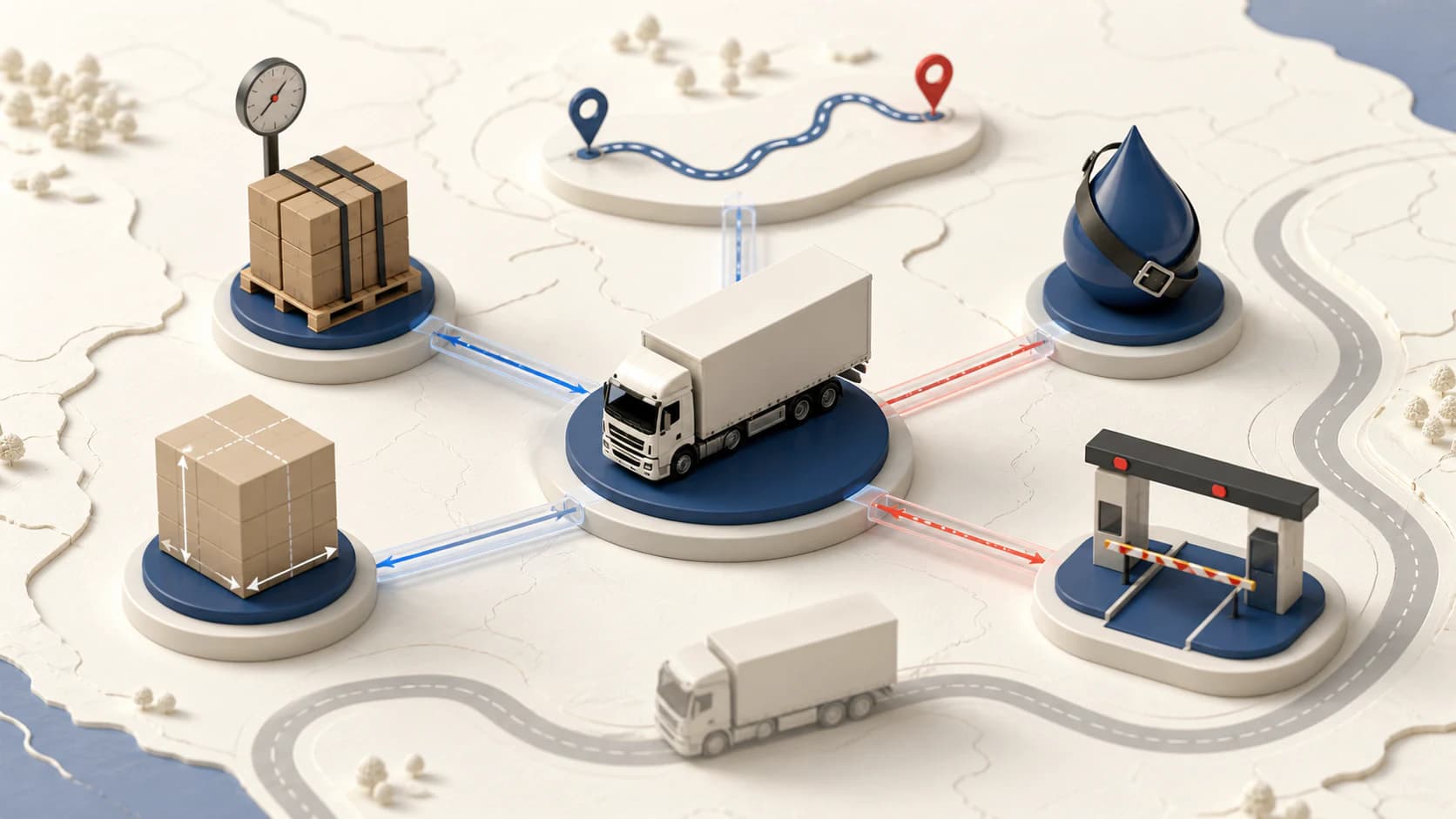
The most common mistake in pricing is treating a trip as one-way. Every run where the vehicle finds no return load carries a hidden cost inside the outbound rate. A carrier who leaves that share out of the price ends the quarter losing money on jobs that looked profitable on paper.
A road freight rate (navlun) is the price charged for carrying a consignment from the collection point to the delivery point. Three variables set the number: the weight of the load, the volume it occupies, and the distance in kilometres. A price built before those three are known is an estimate, not a quote.
The awkward part first: there is no single magic formula. The formula varies according to each company's own tariff, and market conditions keep moving that tariff. What does not change is the method — which items enter the calculation, and which ones get left out every time.
What breaks a freight rate is rarely bad arithmetic. It is the item that never entered the calculation.
Everyone writes down fuel and the driver. The carrier who leaves out the empty return leg and the tolls along the route ends the quarter losing money on jobs that looked profitable on paper.
What determines a road freight rate?
Road freight pricing is driven by the weight of the load, its volume, and the distance in kilometres. Weight and volume decide how much room the consignment takes on the vehicle. Distance shows how much fuel the vehicle will burn, how many days it will spend on the road, and how many toll gates it will pass on the way.
A vehicle fills up in two separate ways. On some loads the tonnage limit binds first: the trailer is half empty but the vehicle is already at its legal maximum weight.
On others the volume limit binds first; the trailer is packed to the doors while you are well under the tonnage limit. Whichever binds first sets the rate. To put a number on how much trailer floor a shipment takes, use the loading meter calculator.
On distance, the most common mistake is pricing from the straight-line gap between two points. The number that belongs in the price is the kilometre count of the corridor the vehicle will actually drive; intermediate collection points, detours and closed crossings push it up noticeably.
Seferi Route Engine works out distance and duration over the real road route, before the load moves, while you are still preparing the quote.
How do you find volumetric weight, and how many kilograms is a cubic metre?
In road transport, volumetric conversion treats 1 cubic metre as 333 kilograms. You measure the volume of the load in cubic metres, multiply by 333, and that is the volumetric weight. The rate is then built on whichever is greater, the volumetric weight or the actual weight. The freight rate calculator shows which one your own shipment lands on.
| Volume of the load | Volumetric weight (volume × 333 kg) | Actual weight | Basis for the rate |
|---|---|---|---|
| 3 m³ | 999 kg | 400 kg | Volumetric weight |
| 6 m³ | 1,998 kg | 3,500 kg | Actual weight |
| 12 m³ | 3,996 kg | 1,200 kg | Volumetric weight |
The three rows cover the three situations you meet most often in the field. A 400 kilogram consignment occupying 3 cubic metres has a volumetric weight of 999 kilograms, so the rate is built on 999 rather than 400.
On a 3,500 kilogram consignment occupying 6 cubic metres the volumetric weight stops at 1,998 kilograms; the actual weight is higher, so that is the basis. On a light 1,200 kilogram consignment spread over 12 cubic metres the gap widens sharply and the volumetric weight climbs to 3,996 kilograms.
This is where customers push back hardest: the load is a tonne and a half, so why is the price set on four tonnes? The answer is in the trailer.
The vehicle is full and can take nothing behind it. Showing the volumetric weight openly inside the quote ends the argument before it starts.
How does the rate differ between part load and full load?
Road transport has two basic modes: part load (parsiyel) and full load (komple). For a full load, the rate is calculated from the weight of the cargo and the distance to the delivery point. In a part load you pay for the share of the vehicle you occupy alongside the other consignments travelling on it.
| Criterion | Part load (parsiyel) | Full load (komple) |
|---|---|---|
| Unit the rate is built on | The weight or volume share you occupy | The whole vehicle |
| Route | Detours for collection and distribution | Straight from collection to delivery |
| Transit time | Depends on the vehicle filling and the drop order | Known the moment the vehicle rolls |
| Handling | At least once at the transfer hub | Goods are never taken off |
| Empty return risk | Stays with the carrier, spread across unit prices | Sits directly with whoever quotes |
| Critical data in the quote | Accuracy of dimensions and volume | Accuracy of distance and tolls |
| Suits which cargo | Regular shipments that do not fill a vehicle | Loads that fill a vehicle or cannot be split |
In a part load the rate is built on the weight or volume share you occupy; in a full load it is built on the whole vehicle. That difference shows up in the route as well: a part-load vehicle detours to collect and distribute, while a full-load vehicle runs straight from the collection point to the delivery point.
Transit time follows from the same fact — in a part load you wait for the vehicle to fill and for your position in the drop order, whereas in a full load the timing is known the moment the vehicle rolls.
On handling, a part-load consignment is taken off and reloaded at least once at the transfer hub, while a full load never leaves the vehicle it was loaded onto. Damage risk and packaging requirements are therefore not the same across the two modes.
Empty return risk changes hands too: in a part load it stays with the carrier and is spread across unit prices, whereas in a full load it sits directly with whoever gave the quote.
The data you have to get right also changes. In a part load, accuracy of dimensions and volume is critical, because volumetric weight sets the price directly.
In a full load, accuracy of distance and tolls is what matters. In short: a regular shipment that does not fill a vehicle suits a part load, while a load that fills the vehicle or cannot be split suits a full load.
Spreading the jobs you hold across as few vehicles as possible arrives at exactly this point. Nobody splits thirty jobs across twenty vehicles in their head; people apply the first sensible allocation they can see, and the wasted kilometres stay invisible.
Seferi Optima runs that calculation in the background and hands back a plan: how many vehicles, in what order, carrying which jobs.
Have distance, duration and the tolls along the route ready on the quoting screen. Gate by gate, not as a lump-sum guess.
Try it with your own lanesWhich cost items sit inside a freight rate?
A freight rate is not one expense but the sum of eight separate items. Some of them are born with the trip and are invoiced immediately; others arrive months later, and that is precisely why they never get written against the trip that caused them.
| Cost item | Where it comes from | Common mistake |
|---|---|---|
| Fuel | The real kilometres of the corridor and the vehicle's consumption | Priced off straight-line distance, detours ignored |
| HGS motorway toll system, motorway and bridge crossings | The sum of the individual gates along the route | Waved through with a lump-sum toll allowance |
| Driver cost | Wages, per diem, accommodation and the number of days on the road | Only the salary is counted, days on the road are ignored |
| Tyre and maintenance share | The wear attributable to each kilometre driven | No invoice arrives that month, so nothing is charged to the trip |
| Insurance | Carrier liability and vehicle policies | Treated as an annual expense, never allocated per trip |
| Empty return | The return mileage of a trip with no backload | The trip is counted as one-way, the item is erased entirely |
| Waiting time | Hours spent at loading and unloading points | No free waiting period is defined in the quote |
| Subcontractor share | The trip price paid to a hired or owner-driver vehicle | Assumed to cost the same as running your own vehicle |
Fuel comes out of the real kilometres of the corridor and the vehicle's consumption; priced off a straight-line distance with detours ignored, it always falls short. The HGS motorway toll system together with motorway and bridge crossings is the sum of the individual gates along the route, and waving that through with a lump-sum toll allowance is the most widespread shortcut in the trade.
Driver cost covers per diem, accommodation and the number of days the trip will take alongside the wage; counting only the salary ignores the days spent on the road.
The tyre and maintenance share is the wear attributable to each kilometre driven. Because no invoice lands that month, nothing is charged to the trip — even though the wear happened during it.
Insurance behaves the same way: it arises from carrier liability and vehicle policies, gets treated as an annual expense, and is never allocated per trip. The empty return is the return mileage of a trip with no backload; counting the trip as one-way erases the item completely.
Waiting time is the hours spent at loading and unloading points, and it cannot be charged at all when the quote defines no free waiting period. The subcontractor share is the trip price paid to a hired or owner-driver vehicle, and it cannot be assumed to cost the same as running your own.
All eight items are present on every trip. What differs is which of them are invoiced that day. The items with no immediate invoice — the maintenance share, insurance, the empty return — never show up in the quote, and they eat the margin quietly.
Why are the empty return and tolls the two most forgotten items?
Because neither is visible at the moment of quoting. The empty return has not happened yet, and the toll bill is not one number but many small amounts spread along the corridor. Both get left for later, and by the time you look, the job is done.
The logic of the empty return is simple. When you send a vehicle somewhere, the trip does not end there; it either finds a return load or comes back empty.
With no backload, the same corridor is covered twice; fuel, driver cost and toll charges are spent in both directions, but the revenue was collected for one direction only. The difference comes straight out of the margin.
This is why an experienced pricer puts the probability of a return into the price on one-way jobs. On lanes where a backload is unlikely, the rate is built on a round-trip cost rather than a one-way cost; on regular lanes where the return is largely known, that share shrinks. There is no fixed ratio — it varies by lane, by season and with market conditions.
With tolls, the source of error is estimation. Motorway and bridge charges differ by vehicle class, and between the same two points a motorway-heavy corridor and a state-road corridor produce clearly different totals.
A lump-sum toll allowance given without laying out the route falls short on motorway-heavy lanes almost every time. The correct method is to add up the gates on the corridor one by one.
Counting the trip as one-way and covering tolls with a lump-sum guess. Made together, these two errors produce a quote that looks profitable on paper; when the trip closes, it turns out that a good part of the margin was left on the road.
How do you build a quote step by step?
A quote is built in six steps, and the order matters.
- Define the load. Weight, dimensions, volume, packaging type and any special conditions: temperature control, dangerous goods, special securing.
- Calculate the volumetric weight. Find the volume in cubic metres, multiply by 333, compare with the actual weight and take the greater of the two.
- Choose the mode. If the load fills the vehicle or cannot be split, assess it as a full load; if it does not fill the vehicle, assess it as a part load.
- Lay out the real corridor. Work out the actual road distance, the duration and the toll gates on the route through the loading and delivery points.
- Add up the items. Fuel, tolls, driver, maintenance share, insurance, the expected empty return, waiting and the subcontractor share go in one by one.
- Write down the margin and the validity period. Add the profit margin and state clearly the date until which the quote holds.
The sixth step is the one most often skipped. Because fuel and toll charges move with market conditions, a quote given with no expiry turns into a commitment that works against you after a while.
Where the enquiry comes from is part of this flow too. In logistics the job usually starts inside an email; the address, the dimensions and the weight are buried in the body of the thread. Seferi Posta lets you mark the parts of an incoming enquiry that belong in the quote, and the quote goes back as a reply on the same thread.
Most firms running this calculation by hand hit the same wall eventually: every quote lives in its own file, old files keep old costs when the tariff changes, and nobody can say which price was given on which assumption. We covered where that breaks down in detail in where transport tracking in Excel breaks down.
How does the calculated rate carry into the invoice?
The rate in the quote and the amount on the invoice have to match; every gap turns into reconciliation work afterwards. Waiting, extra stops, returns and empty runs cannot be written onto the invoice if the quote never defined them.
This is why the text of a quote is not a price line but a scope definition. It states plainly what the rate includes, what is subject to an extra charge, and under which conditions the price will be reassessed. We covered which details and which documents an invoice is issued on in how to issue a transport invoice.
One last point: a freight rate calculation is not a spreadsheet you build once and shelve. Fuel, tolls and subcontractor vehicle rates all move with market conditions, and how much delay your tariff carries in reflecting that movement decides how much of your margin you keep.
Running the eight items inside a freight software rather than a fresh spreadsheet per quote is what keeps the tariff current: distance, tolls and cost lines are recalculated each time instead of inherited from whichever file was copied. What changes when that costing is produced automatically rather than typed in is the subject of the AI-powered freight software page.
Try it on your own lanes — see how long a quote takes once distance, tolls and cost items sit on a single screen.
Try 14 days freeFrequently asked questions
What information do you need to calculate a freight rate?
You need at least three things: the weight of the load, the volume it occupies, and the distance to the delivery point in kilometres. Weight and volume decide how much room the consignment takes on the vehicle, while distance shows how much fuel the vehicle will burn, how many days it will spend on the road, and how many toll gates it will pass. To those you add the packaging type, the number of loading and unloading points, any temperature-controlled or dangerous-goods condition, and the waiting time you expect. A price given while any of this is missing is a guess rather than a quote, and the gap usually surfaces only after the trip has closed. The freight rate formula also varies according to each company's own tariff, so two different carriers quoting the same load will often differ simply because their tariffs and their cost assumptions differ.
How many kilograms is one cubic metre in road transport?
In road transport, volumetric conversion treats 1 cubic metre as 333 kilograms. You measure the volume of the load in cubic metres, multiply by 333, and that gives you the volumetric weight. The rate is then built on whichever is greater, the volumetric weight or the actual weight. A 400 kilogram consignment that takes up 3 cubic metres has a volumetric weight of 999 kilograms, so the price is set on 999 rather than 400. By contrast, a 3,500 kilogram consignment occupying 6 cubic metres has a volumetric weight of only 1,998 kilograms, so the actual weight governs. The logic is simple: a light but bulky load fills the trailer, and that vehicle can take nothing else. What the customer pays for is not kilograms but occupied capacity.
Is part load (parsiyel) or full load (komple) the better option?
The decision comes down to whether the consignment fills the vehicle. Road transport has two basic modes, part load (parsiyel) and full load (komple). For a full load, the rate is calculated from the weight of the cargo and the distance to the delivery point, and the vehicle runs straight from the collection point to the delivery point; the goods are never taken off, and the transit time is known the moment the vehicle rolls. In a part load you pay for the share of the vehicle you occupy alongside other consignments; the vehicle detours to collect and distribute, the goods are handled at least once at a transfer hub, and the transit time depends on the vehicle filling up. The practical test is this: a load that fills the vehicle or cannot be split belongs in a full load, while a regular shipment that does not fill a vehicle belongs in a part load. Urgency and damage sensitivity push the decision towards full load.
How is the empty return leg reflected in the rate?
The empty return is the return mileage of a trip that finds no backload, and it enters the price according to how likely a return load is on that lane. When you send a vehicle somewhere, the trip does not end there; either it picks up a return load or it comes back empty. When there is no backload, the same corridor is covered twice, fuel, driver cost and tolls are spent in both directions, but the revenue was collected for one direction only. On lanes where a return load is unlikely, the rate is therefore built on a round-trip cost rather than a one-way cost. On regular lanes where the return is largely known, that share shrinks. There is no fixed percentage; the decision depends on the lane, the season and the market conditions of the period. What matters is not that the item appears at some standard level, but that it is set deliberately rather than left out.
Are tolls and the HGS motorway toll system included in the rate?
They usually are, but the quote has to say so in writing. Motorway and bridge charges are the sum of the individual gates along the route; they are not one line item but a series of crossings spread over the corridor. The amount differs by vehicle class, and between the same two points a motorway-heavy corridor and a state-road corridor produce clearly different totals. That is why a lump-sum toll allowance given without laying out the route usually falls short on motorway-heavy lanes. The correct method is to add up the gates on the actual corridor one by one while the quote is being prepared and carry that figure into the cost items. If the route changes later — a closed road, an extra stop, an alternative crossing — the quote should already define how that change feeds into the price.
Sources and references
- Inter-city distance chart — General Directorate of Highways (KGM)
- Motorway and bridge toll tariffs — General Directorate of Highways (KGM)
- Road Transport Regulation — mevzuat.gov.tr
- Ministry of Transport and Infrastructure — road transport rules
- UTIKAD — logistics sector publications and glossary
- EPDK — fuel price data
This article is for general information; consult the relevant authority or your accountant for binding interpretation.
Last updated: