

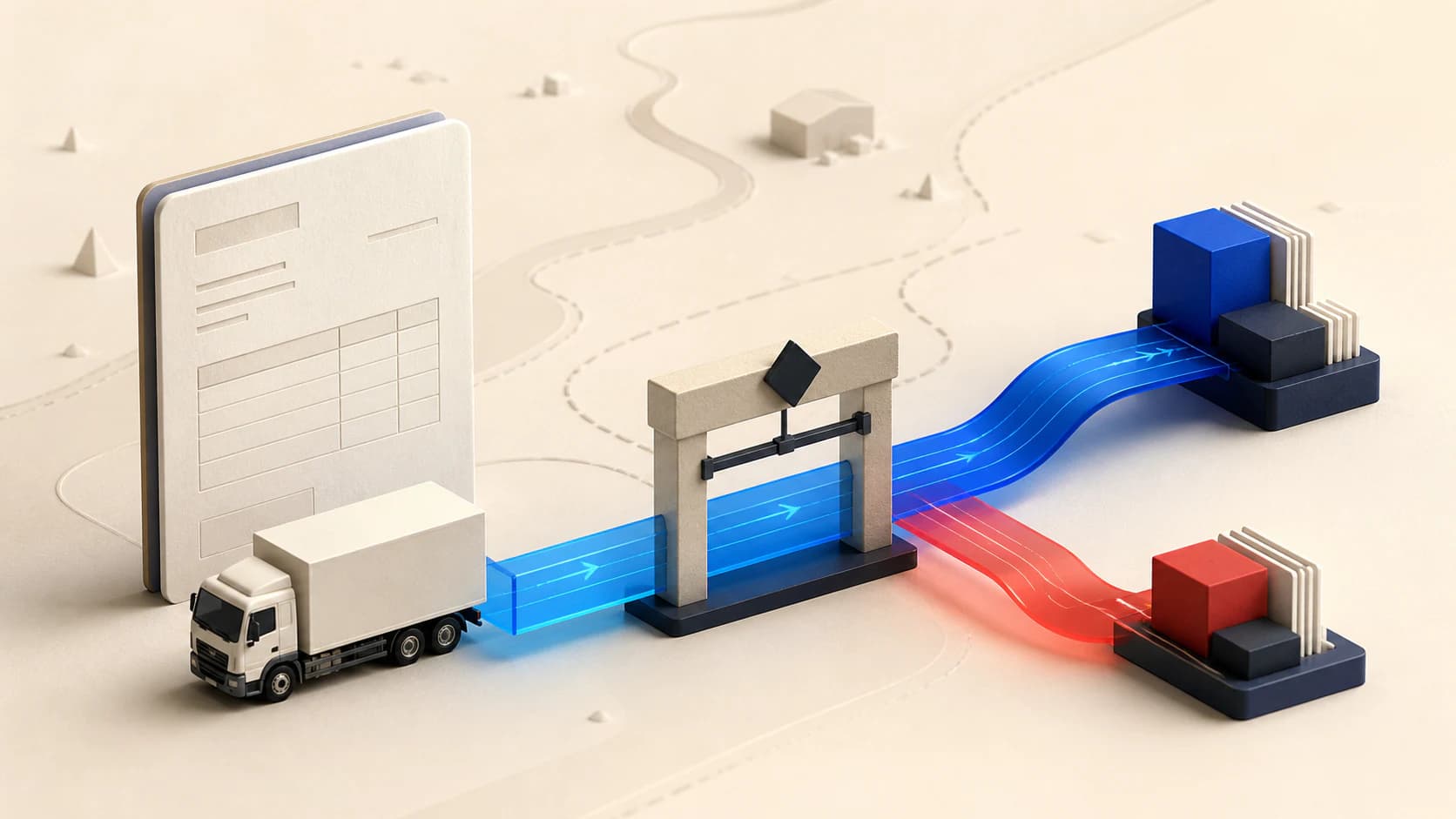
Checking the threshold against the service fee is the most expensive habit in the field. The check is made on the VAT-inclusive total: even when the fee looks safely below the limit, if adding VAT pushes the total over it, withholding becomes mandatory and an invoice issued without it counts as incomplete.
VAT withholding (tevkifat) on transport means that part of the VAT calculated on a haulage service is not paid to the carrier at all. The buyer keeps that part back and declares it directly to the tax office as the responsible party. The rule itself fits into a single sentence. What actually goes wrong sits somewhere else: which service falls under which rate, which figure the threshold is measured against, and whether the buyer is VAT-registered in the first place. Mistakes collect at those three points.
This article walks through the threshold in force for 2026, the rate that applies to freight transport, and the errors that carriers operating in Türkiye run into most often at the moment the invoice is raised.
For an overview of how the invoice is fed by the quote and trip steps, see Freight Invoicing and VAT Withholding Tracking.
What is the VAT withholding rate on a freight invoice?
Freight transport services carry partial VAT withholding at 2/10. Two tenths of the calculated VAT is not paid to the carrier who issued the invoice; the buyer shows that portion in its own return as the responsible party and pays it to the tax office. The remainder is paid to the carrier exactly as it would be on any other invoice.
The rate does not move with the type of cargo. It does not move with distance, vehicle type, or whether the leg is domestic. The single thing that decides it is whether the service qualifies as freight transport. Shuttle transport, by contrast, is defined as a separate service in the legislation and carries its own rate, which is where a large share of the confusion begins.
The split is visible on the face of the invoice. The calculated VAT is written out, the portion subject to withholding appears on its own line, and the amount to be collected falls accordingly. From the carrier's side the practical consequence is blunt: for the same service fee, less cash arrives than it would on an invoice without withholding.
That gap is not lost revenue: what changes is only which part of the VAT is paid by whom. Even so, for a business that plans cash weekly, a movement in the collected amount belongs in the collection calendar rather than being discovered when the payment lands short.
| Service and buyer status | Withholding rate | Threshold check |
|---|---|---|
| Freight transport — buyer is VAT-registered | 2/10 | Applies if the VAT-inclusive total exceeds 12,000 TL |
| Shuttle transport (personnel or student) — buyer is VAT-registered | 5/10 | Applies if the VAT-inclusive total exceeds 12,000 TL |
| Buyer is not VAT-registered (individual customer) | Not applied | Amount is not considered |
Those three rows answer very nearly every question that comes up in practice. Freight transport is withheld at 2/10, shuttle transport at 5/10, and there is no withholding at all when the buyer is an individual who is not VAT-registered. One question is left over, and it is the one that produces the costly mistakes: which figure is the threshold measured against?
What confuses carriers is rarely the rate itself. It is that two invoices issued to the same customer behave differently: one trip in the month stays under the threshold, the next one clears it. The rule has not changed; only the amount has. That is why the withholding decision is taken per invoice, never per customer.
What is the transport withholding threshold in 2026?
The threshold for 2026 is 12,000 TL. Transport invoices that stay below that figure carry no withholding; the whole of the VAT is paid to the party that issued the invoice, and no amount arises for the buyer to declare as the responsible party.
The reason a threshold exists at all is practical rather than principled. Running a separate declaration mechanism for every small invoice would load both sides of the transaction out of all proportion to the tax involved, so the legislation leaves transactions under a stated amount outside the scope.
The figure is not fixed, though. The threshold can be revised every year, and the revision normally takes effect at the turn of the year. An accounting routine still running on last year's number will produce a batch of incorrect invoices in January, and will keep repeating the same error on every invoice until somebody notices. For a finance team looking after a Turkish operation from abroad, this is the one figure worth deliberately re-checking each January rather than assuming it carried over.
The 12,000 TL in this article is the threshold in force for 2026. Withholding thresholds and rates can change every year. Before raising an invoice, confirm the current figure against Revenue Administration announcements and the version of the KDV Genel Uygulama Tebliği (VAT General Application Communiqué) currently in force. This article explains how the rules land in practice; it does not replace your accountant's opinion.
Is the withholding threshold checked on the VAT-inclusive total?
Yes — the threshold is checked against the VAT-inclusive total, not against the service fee. Looking at the fee, concluding that it is "under the limit" and issuing the invoice without withholding produces errors on exactly the invoices that sit near the line.
Take the concrete case. On a job with a service fee of 10,500 TL, the fee looks as though it sits below the 12,000 TL threshold. Once VAT is added, however, the total reaches 12,600 TL, and that figure is above the threshold. The threshold therefore counts as exceeded and withholding becomes mandatory on an invoice that, read carelessly, appeared to fall outside the scope entirely.
| Scenario | Service fee | VAT-inclusive total | 12,000 TL threshold | Withholding |
|---|---|---|---|---|
| Freight transport, buyer VAT-registered | 10,500 TL | 12,600 TL | Exceeded | Yes — 2/10 |
| Freight transport, buyer VAT-registered | A fee whose VAT-inclusive total stays under 12,000 TL | Under 12,000 TL | Not exceeded | None |
| Shuttle transport, buyer VAT-registered | 10,500 TL | 12,600 TL | Exceeded | Yes — 5/10 |
| Freight transport, buyer not VAT-registered | 10,500 TL | 12,600 TL | Not considered | None |
Reading the first and last rows side by side is instructive. The amounts are identical: a service fee of 10,500 TL and a VAT-inclusive total of 12,600 TL in both cases. The outcome still differs, because what decides the question is not the amount on its own but whether the buyer is VAT-registered.
The second row covers the case that stays inside the exemption. Where the VAT-inclusive total lands under 12,000 TL, no withholding is applied and the invoice is issued in the standard way, with the full VAT collected from the customer.
A question that comes up constantly: are invoices issued to the same customer within one month added together for the check? They are not. The threshold is tested on each invoice as it stands, and separate invoices are not aggregated merely because they share a customer. Splitting a single service artificially so each part lands under the threshold is a different matter, and exactly the pattern an audit picks up.
Running the threshold check on the service fee. A fee of 10,500 TL gets invoiced without withholding because it reads as "below 12,000 TL" — while the VAT-inclusive total is 12,600 TL and the threshold has in fact been cleared. The invoice is issued short, and putting it right once the period has closed costs several times what getting it right would have.
Why is shuttle transport treated differently from freight?
Because the legislation defines them as two distinct services, and distinct services carry distinct rates: 2/10 on freight transport, and 5/10 on shuttle services such as personnel and student transport. Everyday language lumps both under "transport", which is where the confusion starts, but the tax treatment never merges them.
The difference lies in what is being carried. Freight transport moves goods. Shuttle transport moves a defined group of people on a regular schedule. Where a company provides both — a routine situation in mixed fleets — each invoice has to be assessed on the service it actually covers.
In practice the error takes a predictable shape. The company is used to working at 2/10 on the freight side, and raises the personnel shuttle invoice on the same reflex. Or the reverse happens and 5/10 is applied to a freight invoice. Either way the invoice is wrong, the buyer's declaration inherits the error, and both documents need correcting.
Goods moving means 2/10. People moving on a regular schedule means 5/10. If you supply both services to the same customer, the rate follows the service, not the customer. Invoicing them separately rather than combining two services on one document keeps both the rate choice and the threshold check straightforward.
Does withholding apply to a buyer who is not VAT-registered?
No — transport invoices issued to individual buyers who are not VAT-registered carry no withholding. Even where the amount sits well above the 12,000 TL threshold the outcome does not change, and the whole of the VAT is paid to the party that issued the invoice.
The reason is in the mechanism rather than in any special exemption. Withholding works by having the buyer declare part of the VAT as the responsible party. Where the buyer carries no filing obligation, there is nobody on the other side to make that declaration, so the mechanism has nothing to run on and simply does not engage.
This distinction matters most to household removals firms and groupage operators, whose customer base mixes companies and private individuals week by week. A carrier that invoices a corporate customer on Monday and a private customer on Thursday is applying two different rule sets to what looks, operationally, like the same job. We walked through the whole invoicing flow step by step in how to issue a transport invoice.
When the trip, the freight rate and the invoice move through one flow, the withholding decision is not hunted down by hand. The amount and the customer type are already on the record.
Freight Invoicing and VAT Withholding TrackingWhat changes in operations when you issue an invoice with withholding?
What changes is not the accounting entry but the data the invoice rests on. To raise an invoice with withholding correctly, three facts have to be in your hands, and accurate, at the moment of invoicing: the type of service, the VAT-inclusive total, and the buyer's registration status.
Two of those three originate in operations rather than in accounting. The service type is evident from the trip itself. The amount comes out of the freight rate, and how that rate is built — which line items are folded into the total and which are billed separately — feeds directly into the threshold check. We went into that in detail in how to calculate a freight rate.
On the e-invoice side, the withholding code that corresponds to the service has to be selected. A code exists for each service type, and when the wrong one is chosen the invoice may well pass validation while still producing an inconsistency on the declaration side. Confirm the current code list against the Revenue Administration and your e-invoice integrator's documentation.
For companies running subcontracted vehicles the picture doubles. The company invoices its own customer on one side and receives an invoice from the sub-carrier on the other. Each document is assessed separately on its own amount and its own service type; withholding arising on one says nothing about whether it arises on the other.
The real difficulty is that these facts sit scattered: the trip in one place, the freight rate in a spreadsheet, the customer's registration status on a card nobody opens. At invoicing time they are stitched together by hand, and that is where the error is born.
Where do withholding mistakes actually come from?
Almost all of them fall into a small set of patterns. The table below puts the way each mistake looks in practice next to the correct treatment and the reason it matters.
| Common practice | Correct treatment | Why it matters |
|---|---|---|
| Threshold checked against the service fee | Checked against the VAT-inclusive total | Invoices near the limit are issued short |
| Freight rate applied to a personnel shuttle invoice | Shuttle 5/10 and freight 2/10 assessed separately | A rate error corrupts the declaration too |
| Withholding applied to a private customer | No withholding where the buyer is not registered | The buyer cannot declare it; the invoice is reissued |
| Last year's threshold still in use | Current figure verified at the turn of the year | Produces errors in bulk during January |
| Decision taken per customer | Decision taken per invoice | The same customer can produce both outcomes |
The last row is the one most often waved away. "We invoice this customer with withholding" sounds like a sensible shortcut and is simply wrong. Of two invoices to the same customer, one may land below the 12,000 TL threshold and the other above it; the first carries no withholding and the second carries 2/10, and no customer-level rule can cover both.
How does this check become automatic?
The check automates itself once the amount and the customer record exist before the invoice does. When the trip is opened, the customer, the service type and the freight rate have already been entered; at the invoicing stage there is nothing left to go looking for.
There is a timing dimension as well. The withholding decision is taken at the moment of invoicing, but every piece of data behind it is created during the trip. The wider the gap between those two moments, the higher the chance the information arrives incomplete or stale.
At period end a different question turns up: how many invoices carried withholding this month, which service type dominated with which customer, which invoices ran close to the threshold and might behave differently next month? None of these are answered invoice by invoice. They are answered by looking at the period as a whole, and on the Seferi reporting side you can see period revenue and its line items at that level.
When the invoice, the trip, the waybill and the statutory notification move as parts of the same record, the withholding decision stops being a question anybody has to raise separately. You can see which module takes which step on the features page. That is the practical case for keeping all four inside one freight software: the service type and the VAT-inclusive total are already on the record before anyone opens the invoice screen.
One closing reminder: rates, thresholds and withholding codes should all be confirmed from a current source before an invoice goes out, and the turn of the year is when the threshold is most likely to have moved. Revenue Administration announcements are the reference, and checking them once a year remains the cheapest control available.
When the trip, the freight rate and the invoice live on a single record, the withholding check takes care of itself. See it running on your own trips.
Try 14 days freeFrequently asked questions
What is the VAT withholding rate on a freight transport invoice?
Freight transport services carry partial VAT withholding at 2/10. Two tenths of the calculated VAT is not paid to the carrier; the buyer declares that portion to the tax office as the responsible party. The remainder is paid to the carrier who issued the invoice, exactly as usual. The rate does not move with the type of cargo, the distance or the vehicle used; the only thing that decides it is whether the service qualifies as freight transport. On the invoice, the portion subject to withholding is shown on its own line and the amount to be collected drops accordingly.
What is the transport withholding threshold for 2026?
The threshold for 2026 is 12,000 TL. Transport invoices below that figure carry no withholding and the whole of the VAT is paid to the seller. Because the threshold can be updated every year, the figure in force has to be verified from Revenue Administration announcements at the start of each year. Carrying on with last year's number produces a batch of incorrect invoices in January and repeats the same error on every invoice until someone notices. Updating the figure once at the turn of the year is far cheaper than correcting invoices one by one.
Is the withholding threshold checked on the VAT-inclusive total?
Yes, the check is made on the VAT-inclusive total rather than the service fee. On a job with a service fee of 10,500 TL the fee appears to sit below the 12,000 TL threshold; once VAT is added the total reaches 12,600 TL, so the threshold counts as exceeded and withholding becomes mandatory. Deciding on the fee alone produces errors precisely on the invoices that sit near the limit. The check is also made invoice by invoice: separate invoices issued to the same customer within a month are not added together.
Why is the rate different for shuttle transport?
Shuttle transport and freight transport are defined as separate services in the legislation, so they carry separate rates. Shuttle services such as personnel and student transport are withheld at 5/10, while freight transport is withheld at 2/10. The difference lies in what is carried: freight transport moves goods, shuttle transport moves a defined group of people on a regular schedule. A company that provides both has to assess each invoice on its own service type, and applying one service's rate to the other is a common error.
Does withholding apply to a buyer who is not VAT-registered?
No. Transport invoices issued to individual buyers who are not VAT-registered carry no withholding. Withholding rests on the buyer declaring part of the VAT as the responsible party, and that mechanism cannot run where the buyer has no filing obligation. The outcome does not change even when the amount is above the 12,000 TL threshold, and the whole of the VAT is paid to the party that issued the invoice. Companies that invoice a corporate customer and a private customer in the same week frequently miss this distinction.
Sources and references
- Revenue Administration (Gelir Idaresi Baskanligi) — official portal
- KDV Genel Uygulama Tebligi (VAT General Application Communique) — mevzuat.gov.tr
- VAT withholding on transport invoices — Parasut
- Withholding on transport invoices — Mikro Yazilim
- Transport withholding threshold 2026 — calculation and application guide
- Transport withholding rate and withholding code 2026 — KobiTime
This article is for general information; consult the relevant authority or your accountant for binding interpretation.