

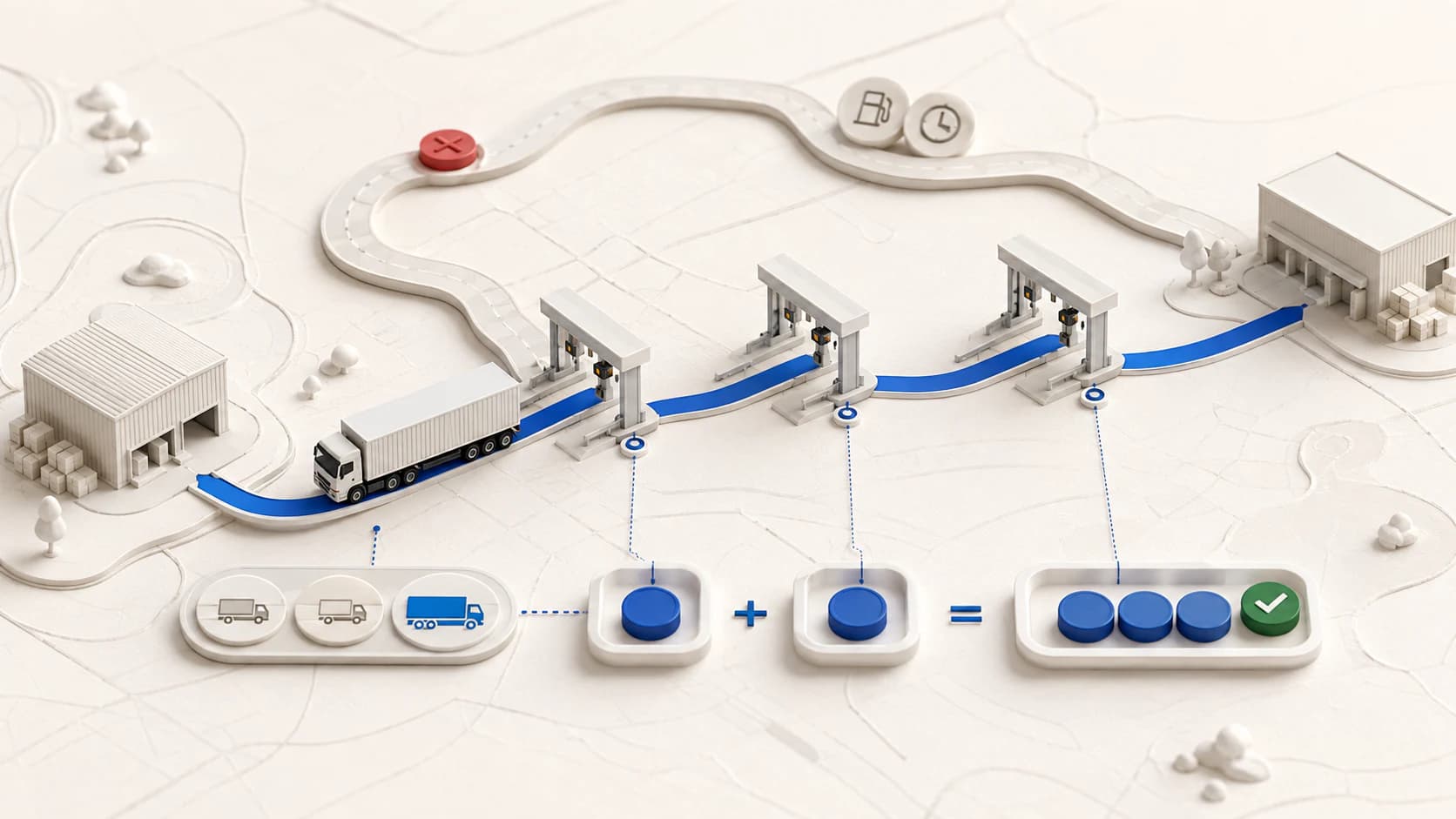
The most common mistake at the quoting desk is rounding the toll charge off — "it's usually around this much on that route." But the route rarely stays identical trip to trip; one closed road or one extra stop shifts that "around" estimate by a few gates, and the difference comes straight out of the margin.
The toll charge on a route is the sum of every motorway and bridge gate along it. It isn't one line item — it's the total of several separate charges spread across the route, each with its own price.
The most common mistake at the quoting desk is estimating that total: setting aside a round figure because "it's usually around this much on that route." On motorway-heavy routes, that estimate falls short almost every time.
The route rarely stays identical trip to trip. One closed road or one extra stop shifts the "around" estimate by a few gates, and the difference comes straight out of the margin.
What two variables set the toll charge?
For bridges the second variable is already tabulated: the truck toll rates page lists four bridges class by class, taken from the General Directorate of Highways' own documents.
Two variables set the gate charge directly: vehicle class and the number of gates on the route. Neither is fixed — both change trip by trip.
| Variable | What it determines | Common mistake |
|---|---|---|
| Vehicle class | Different vehicle types pay different amounts at the same gate | Treated as if there's a single "motorway rate" |
| Number of gates on the route | Depends on how motorway-heavy versus toll-free the route between two points is | An "average allowance" is set from the straight-line distance |
Tariffs differ by vehicle class; heavy commercial vehicles are generally charged at a higher class than passenger cars. Current tariff tables are updated periodically, so we don't quote a fixed figure here — confirm it directly with the General Directorate of Highways before you act.
How does the gate-by-gate method work?
The correct method isn't estimation, it's addition: the route is worked out first, then every gate on that route is listed one by one, and finally those gate charges are summed. Order matters — you can't know the gate count until the route is set.
- Work out the real road route. Not the straight-line distance — the road the vehicle will actually travel.
- List every gate on that route one by one. Each motorway and bridge crossing is its own gate, not a shared "toll allowance."
- Price each gate by vehicle class. Different vehicle types pay different amounts at the same gate.
- Add the total to the freight rate as its own line item. Fuel and toll charges aren't the same line — they should stay visibly separate.
These four steps can be run by hand, and on short, familiar routes they usually are. The problem shows up when the route changes, or when a closed road appears on it — that's where the hand-tracked "around this much" estimate takes over.
Run by hand, the fourth step is also easy to skip: the toll charge gets folded into the same line as fuel, and the two blur together. Keeping them separate matters for how transparent the quote is — the customer should be able to see what each line costs, especially when a route change means explaining which line moved.
Is the motorway or the toll-free road cheaper?
To answer this from your own records rather than a guess, you need the toll charge kept per trip. The freight tracking Excel template keeps tolls in a column of their own, separate from fuel, so after a few trips the real cost of both routes sits in the same table.
Looking at the toll charge alone is misleading. A toll-free road carries no gate charges, but distance and time are usually longer — which means more fuel and more driver hours.
The right comparison weighs three things together: the toll charge, the fuel difference, and the time difference. A route that looks cheap up front — the toll-free road — can end up costing more overall; on jobs with a tight delivery window, the time difference alone can tip the decision toward the motorway.
| Criterion | Motorway | Toll-free road |
|---|---|---|
| Toll charge | Applies, varies by vehicle class | None |
| Distance and time | Usually shorter | Usually longer |
| Fuel consumption | Can be lower overall due to shorter time | Can be higher due to longer time |
| Tight delivery window | Time advantage stands out | Carries risk |
Seferi Route Service doesn't expect you to run this comparison by hand: distance and duration are calculated on the real road route, every gate on that route is priced individually, and the tariff is applied automatically by vehicle class.
The difference between the motorway and an alternative route is weighed together with fuel and time — before the load moves, while you're still quoting.
Let the toll charge be a real, gate-by-gate figure instead of a guess. Tariffs flow into the system the moment they change; you don't track them by hand.
Try it with your own lanesWhat happens when the route changes?
The toll cost changes directly. A closed road, an extra stop, or an alternative crossing changes both the number of gates on that route and the total charge — sometimes up, sometimes down.
That possibility has to be defined in the quote up front: how the price updates if the route changes later. Otherwise, once the route changes, who covers the extra cost becomes a dispute after the trip has already ended.
Routing around an unwanted toll road entirely is also possible — on some jobs, the customer or company policy may rule out a specific route. That preference has to enter the route calculation from the start, not after the trip has begun.
Where does the toll charge get under-costed?
When the toll charge is under-costed, the difference doesn't disappear — it just goes invisible. The allowance set low at quoting time meets the real invoice once the trip is done, and by then the price is already with the customer; there's no going back.
On a single trip that gap usually looks small. Across thirty trips, the same wrong estimate repeats thirty times, and the total drift shows up directly in month-end margin.
A second risk is confusing one route with another. A planner might reuse a gate allowance from a familiar route on a different one, assuming it's "roughly the same." If the two routes cross a different number of gates, that assumption turns straight into an error — each route's own gate list has to be totalled for its own trip.
Tariffs themselves aren't fixed either; motorway and bridge charges are updated periodically. Costing a route's toll share with last year's figure produces a different total than the current tariff would — which makes tariff currency as important a check as the route itself.
Where does the toll charge sit in the freight rate?
The toll charge is only one line in the freight rate — but it's the one most often skipped or misjudged. We covered the rest of the freight rate's line items, and where the toll charge sits inside that total, in how is road freight rate calculated.
If you want the full trip cost — fuel, driver, maintenance, depreciation and tolls included — how is freight cost calculated lists all ten items one by one. You can also see which items the toll charge affects alongside profit per vehicle inside that same calculation.
See it on your own routes: what the cost comes to when the toll is attached to the trip record from the start.
Try 14 days freeFrequently asked questions
How does the toll charge change with vehicle class?
Motorway and bridge tariffs differ by vehicle class; heavy commercial vehicles are generally charged at a higher class than passenger cars. Current tariffs and class tables should be confirmed directly with the General Directorate of Highways — rates are updated periodically, and we deliberately don't quote a fixed figure here.
Is a toll-free road always cheaper than the motorway?
No. A toll-free road carries no gate charges, but distance and time are usually longer — which means more fuel and more driver hours. The right comparison weighs the toll charge together with the fuel and time difference, not on its own; a route that looks cheap up front can end up costing more overall.
Does the toll cost change if the route changes?
Yes, directly. A closed road, an extra stop, or an alternative crossing changes the number of gates on the route and the total charge with it. How that possibility feeds back into the price has to be defined in the quote up front — otherwise who covers the extra cost once the route changes becomes a dispute after the fact.
Sources and references
- Motorway and bridge toll charges — General Directorate of Highways
- Inter-city distance table — General Directorate of Highways
- Road Transport Regulation — mevzuat.gov.tr
This article is for general information; consult the relevant authority or your accountant for binding interpretation.