

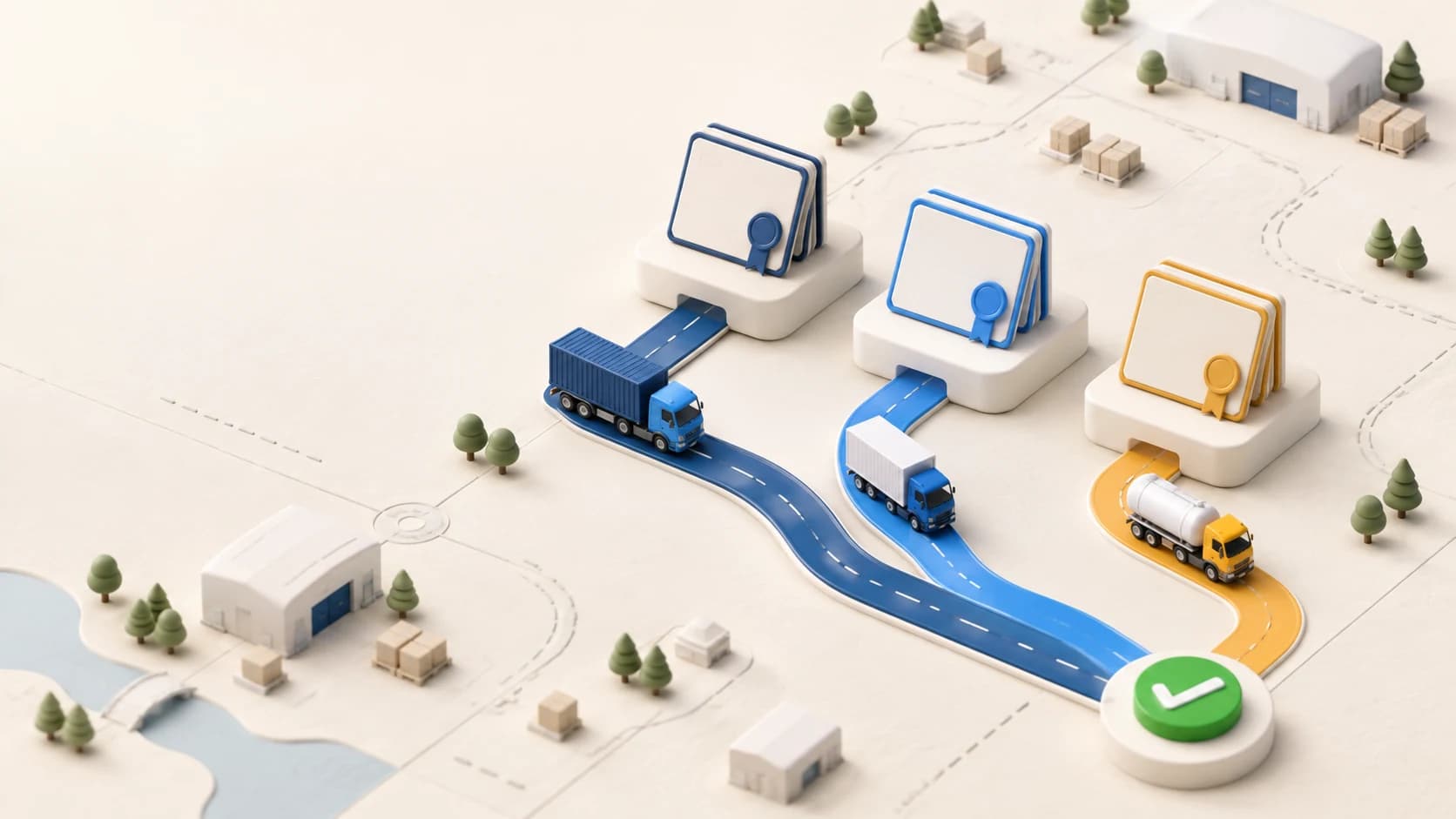
The licence question is almost never settled by asking which trucks you own. Same tractor, same trailer, same driver — but moving your own goods needs one licence and moving a customer's goods for a fee needs another. The decision sits in the nature of the work, not the vehicle. As a fleet grows, the most expensive mistake is the business model changing while the licence stays the same.
The most common misconception when choosing an operating licence is that the decision is made by looking at your fleet. In fact the same tractor, the same trailer and the same driver can require two different licences.
What decides it is the nature of the work: are you moving your own goods or someone else's for a fee, does the carriage stay inside the country or cross the border, and do you perform the carriage yourself or take it on and have someone else perform it?
This article is not legal advice but a filter to use before deciding: which question puts you in which scope. The final decision has to be confirmed from an official source.
The three questions that decide it
- Whose goods are you carrying? Your own, or your customer's?
- Are you paid for it? Is the carriage sold as a service in its own right?
- Where does the carriage stay? Domestic, or across the border?
The answers largely determine the scope. There is a fourth question, and it is the one that catches fleets out most: do you perform the carriage, or take it on and have someone else perform it?
What the licence types broadly cover
The table below is a filter; for exact boundaries and exceptions, the regulation as currently in force is the reference.
| Licence | Who it is for | The distinguishing question |
|---|---|---|
| K1 | Domestic carriage of goods for a fee | Are you carrying someone else's goods for money? |
| K2 | Carrying your own goods for your own business | Are you carrying only your own goods? |
| K3 | Household and office removals | Is what you carry household or office goods? |
| C2 | International commercial carriage (existing C2s were converted to L2 in 2023) | Does the carriage cross the border? |
| L1 / L2 | Logistics operations (domestic / international) | Do you also provide storage, handling and similar services? |
| TİO (formerly R1 / R2) | Freight organising — a separate regulation, no vehicle requirement | Do you take the work on and have someone else perform it? |
Each row defines a scope, not a vehicle type. That is why one company can fall into more than one row.
The three most common mistakes
1. The business model changes, the licence does not
A company that took a licence to move its own goods starts taking customer loads to fill empty returns. Same truck, same driver — but the work is now carriage for a fee. The licence does not cover that scope.
This is the most expensive mistake as a fleet grows, because it is hard to notice: nothing breaks, you simply turn out to be outside scope at an inspection one day.
2. Assuming "no trucks, no responsibility"
Taking on carriage and having a subcontractor perform it does not transfer responsibility. Who took the work on comes before who owns the vehicle. We covered who is held responsible in who pays the K belgesi fine.
3. Crossing the border on a domestic licence
Performing international carriage on a domestically scoped licence is activity outside authorisation, even though you hold a licence. It is not the existence of the licence that protects you but its scope.
In companies running owned and subcontracted vehicles together, the sentence we hear most is: "we can't work out afterwards which trip ran under which licence."
Even when the licence type is chosen correctly, if the record does not say which scope a trip ran under, there is nothing left to prove at an inspection.
Why fees and conditions are not published here
Licence fees, the minimum capacity conditions required and the list of documents requested are updated every year. Writing a fixed figure on this page would mean giving you something with a high chance of being wrong by the time you read it.
Verify current fees and conditions with the Ministry of Transport and Infrastructure and the authorities concerned. While deciding, settle the scope before the figure; a cheap licence in the wrong scope costs far more than an expensive one in the right scope.
Getting the licence is not the end of the job
Once the licence is issued, the next step is registering vehicles to it; a vehicle card is produced for each and kept in the vehicle. We covered that step in what a vehicle card is.
And it does not end there: vehicles are added as they arrive, removed as they are sold, and the licence is renewed when it expires. How that registration actually works is set out in adding a vehicle to a K belgesi. As the fleet grows, this upkeep becomes the actual work.
The licence also brings reporting duties with it: journeys and loads have to be declared to U-ETDS, and failing to do so is a separate heading with its own penalty — see how much the U-ETDS fine is.
When which trip ran with which vehicle and driver, under which scope, sits on one record, the question "can we work this out afterwards" never comes up. Vehicle and driver are captured the moment the trip is opened.
Try it with your own tripsChecklist before deciding
- What share of what you carry today is your own goods, and what share your customers'?
- Do you take customer loads on empty returns?
- Do you plan cross-border carriage, and when?
- Do you have subcontractors perform part of the carriage?
- Do you sell additional services such as storage or handling?
If you answered yes to the second, third or fourth, your current licence probably does not suffice on its own. The first thing to do in that case is not to apply for a licence but to write down which scope you actually operate in.
The filing obligation runs alongside the licence rather than replacing it; see the U-ETDS page.
See it with your own fleet: which trip runs under which certificate, and which vehicle is registered to it.
Try 14 days freeFrequently asked questions
What is the difference between a K1 and a K2 licence?
The difference is whose goods you carry. K1 is for those carrying someone else's goods for a fee; K2 is for a company carrying its own goods in connection with its own core business, without commercial intent. A company that took a K2 to move its own goods falls outside scope the moment it starts carrying a customer's goods for payment.
I move my own goods in my own truck. Do I still need a licence?
Usually yes — but a different type from those carrying for a fee. Moving your own goods in connection with your core business also falls within the operating licence regime, and a separate licence type exists for it. Because exemptions can vary by vehicle type and the nature of the carriage, confirm your situation with the Ministry of Transport and Infrastructure.
I have no trucks, I only organise the work. Which licence applies?
If you take on the carriage without your own vehicles and have someone else perform it, that falls under freight forwarding and has its own licence type. Not owning vehicles does not remove the obligation; because you are the party who took on the carriage, the responsibility is yours.
I will carry abroad. Is my K licence enough?
No. K licences cover domestic carriage; international carriage of goods requires a separate licence type. Performing cross-border carriage on a domestic licence counts as activity outside authorisation even though you hold a licence.
Can you hold more than one licence at the same time?
If your business model falls into more than one scope, then yes, more than one licence may be required. For example, if you both move your own goods and provide paid carriage to third parties, two distinct scopes are involved. Verify which combination applies to you from an official source.
Sources and references
- Ministry of Transport and Infrastructure (UAB)
- Road Transport Regulation — mevzuat.gov.tr
- Road Transport Law (4925) — mevzuat.gov.tr
- e-Devlet portal — operating licence procedures
- U-ETDS — official portal of the Ministry of Transport and Infrastructure
This article is for general information; consult the relevant authority or your accountant for binding interpretation.
Last updated: