

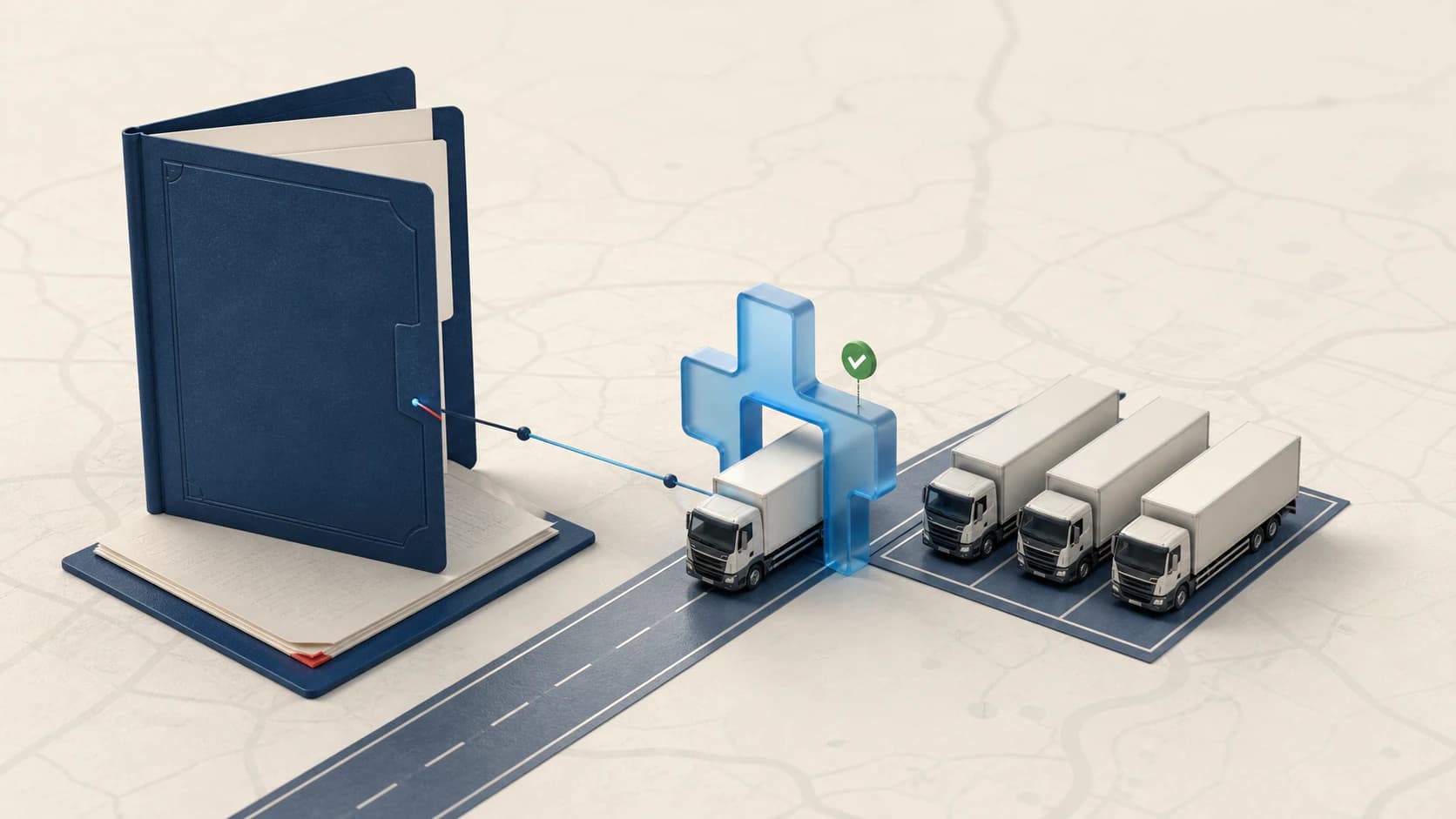
Putting a vehicle to work before its certificate registration is finished is the most expensive habit in fleet growth. The vehicle is delivered, a driver is assigned, it loads the next morning — while the certificate application waits its turn in a queue. Every trip made in that gap looks, in a roadside inspection, like transport performed outside the authorisation certificate.
The visible part of growing a fleet is buying the vehicle. The invisible part is adding it to your authorisation certificate (yetki belgesi). Skip that second step and the vehicle works in the field but does not exist in the fleet on paper.
What is a K certificate, and why is each vehicle registered separately?
K-type authorisation certificates (yetki belgesi) are issued for domestic goods transport. K1 covers domestic goods transport carried out commercially; K3 covers household and office goods transport. The certificate is issued to the company; the vehicles that actually perform the transport are registered under it one by one.
The distinction matters in practice. Holding an authorisation certificate does not put every vehicle in your yard automatically inside its scope. In a roadside inspection two questions are asked independently: does the company hold a valid authorisation certificate, and is this vehicle, the one just stopped, registered under it?
If the answer to the second question is no, the vehicle is outside the scope even when the answer to the first is yes. That is the trap carriers fall into while growing, because growth is the period in which vehicles arrive faster than paperwork closes.
The most common failure we see in the field is a vehicle put to work before its certificate registration is complete. It is delivered, insured, given a driver, and loads the next morning; the application goes into a queue. Every trip made in that gap looks, in an inspection, like transport performed outside the authorisation certificate.
How does the process of adding a vehicle actually work?
Authorisation certificate procedures run through the Ministry of Transport and Infrastructure's U-Net system. An application to add a vehicle is filed through that same system, via Ministry units or authorised bodies. At its core the process verifies two things: that the vehicle is suitable for the certificate type, and that the company genuinely holds the right to use it.
The general flow: the vehicle's registration and technical details are assembled, the application is entered into the system, its suitability for the certificate type is checked, a vehicle card is issued for an approved vehicle, and the plate is written into the certificate annex. Only then does the vehicle count as being inside the certificate.
The documents requested and the conditions applied change from period to period. Filing this year with the folder you assembled last year is a reliable way to lose time to a missing paper. Asking the authorised body for the current list before you build the file is faster than doing the job twice.
Authorisation certificate fees, the conditions applied and the requested document list are updated every year. No figure is given in this article, deliberately. Verify current fees and conditions with the Ministry of Transport and Infrastructure and the authorised bodies, and build your application file against that confirmation.
One more note, about planning. Adding a vehicle does not reliably finish within a day, so write the processing time into the calendar when you commit a new vehicle to a customer. Otherwise the date you promised and the date the vehicle can legally work will not match.
What is the difference between own fleet, subcontractor and rented vehicles?
The difference is not who owns the vehicle. It is which authorisation certificate the transport is performed under, and that single sentence decides both the certificate registration and the U-ETDS notification duty.
In Turkish paperwork and official processes, own-fleet vehicles are also called özmal araç, and rented or subcontracted vehicles sözleşmeli araç ("contracted vehicle") — the table below compares these categories by their status on the certificate and by who carries the notification duty.
| Vehicle type | Status on the certificate | Who notifies U-ETDS |
|---|---|---|
| Own fleet — owned by the company | Registered under the company's own K certificate | The certificate holder that undertakes the transport |
| Long-term rental / financial lease | Registered once the right of use is documented; conditions verified with the authorised body | The certificate holder that undertakes the transport |
| Subcontractor vehicle working under your certificate | Whether separate registration is required is verified against current legislation | Your company |
| Subcontractor working under its own certificate | Not registered under your certificate | The subcontractor's own authorisation certificate |
| Spot / single-trip rented vehicle | Status settled before the vehicle starts work | Whichever certificate holder undertakes the transport |
Take the table row by row. Own fleet vehicles, owned by the company, are registered directly under the company's own K certificate, and transport performed with them is notified by the certificate holder that undertook it. This is the chain in its simplest form, and the routine most carriers build.
Vehicles held under long-term rental or a financial lease (the sözleşmeli araç category) are not owned by the company, but the right to use them is. They can be registered on the certificate once that right of use is documented, and the notification duty again sits with the certificate holder undertaking the transport.
Accepted contract types and conditions change from period to period, so confirm them with the authorised body before signing.
A sözleşmeli araç registration also asks whose name the vehicle is registered under. If it belongs to a legal entity (a company), a consent letter and additional corporate documents may be required — a different document set than for a vehicle registered to an individual.
Which documents apply to which certificate type changes with current legislation, so confirm the list with the authorised body before you apply.
When a subcontractor's vehicle works under your certificate, you are the party undertaking the transport, so the notification duty is yours. Whether that vehicle must additionally be registered under your certificate depends on the working arrangement and on current legislation — settle it with an answer from the authorised body, not with an assumption.
When the subcontractor undertakes the transport under its own authorisation certificate, the vehicle is not registered under yours and the notification is made from the subcontractor's certificate. The contractual arrangement on paper then has to be consistent with that claim. In practice this is the most confused scenario, and it usually surfaces only when someone asks who opened the trip record.
Spot or single-trip rented vehicles are the riskiest category. A vehicle brought in within the hour to cover an urgent load sets off before anyone has settled which certificate it works under. Answer that before the vehicle starts work — afterwards there is a completed trip and no record behind it.
The U-ETDS notification duty follows the authorisation certificate, not the ownership of the vehicle. The duty covers K1, K3, C2, C3, L1, L2, N1, N2 and R1 certificates. A trip run by a subcontractor's vehicle under your certificate is therefore notified by you. When the routine built for the own fleet breaks the moment a subcontractor vehicle appears, that break is where most missing notifications are born.
Every plate added to the certificate should be defined in the trip schedule the same day. That is how the gap between the paperwork and the road closes.
Try it with your own vehiclesWhat changes operationally once the vehicle is added?
The moment the vehicle is added, the company's list of obligations grows. The job is not closing a file; it is opening a new operational line. Every paid transport performed with that plate now produces a record that must be notified, documented and tracked.
| Topic | Before the vehicle is added | After the vehicle is added |
|---|---|---|
| Authorisation certificate | The plate does not appear in the certificate annex | The plate is listed in the certificate annex |
| U-ETDS notification | No trip record is opened for this plate | A trip record is opened for every paid transport |
| Transport waybill | The vehicle should not be carrying a load | The waybill travels physically in the vehicle |
| Roadside inspection | The vehicle appears outside the certificate scope | The plate matches the certificate and notification records |
| Trip schedule | The plate is not defined, so no trip can be opened | The plate is defined; driver and route are assigned |
The five rows are one chain. Before the vehicle is added the plate is absent from the certificate annex, no trip record is opened for it, and the vehicle should not be carrying a load; in a roadside inspection it appears outside the scope. Afterwards the plate is listed in the annex, a trip record is opened for every paid transport, the waybill travels in the vehicle, and the plate matches both the certificate and the notification records.
Most carriers overlook the fifth row. If the plate is not defined in the trip schedule, no trip can be opened, and if no trip is opened, no notification is ever born. Even with the certificate side complete, an empty operations side leaves the vehicle working without records. We covered how the notification itself is made in how to make a U-ETDS load notification.
The vehicle has already started working but has not been added to the certificate. The company counts it as part of its own fleet, the driver runs the trip normally, the customer takes delivery of the load. On paper there is no legal basis for the transport, and in an inspection the gap is visible immediately.
What are the most common mistakes when adding a vehicle?
The common denominator is not a lack of knowledge but two records drifting apart: the fleet on the certificate and the fleet in the schedule. The table below sets out the six failures we meet most often, each with its consequence and its prevention.
| Common mistake | Consequence | Prevention |
|---|---|---|
| The vehicle started working but was never added to the certificate | In an inspection it appears outside the scope of the authorisation certificate | Complete the certificate registration before the first trip |
| The plate changed, but neither the certificate nor the schedule was updated | The plate in the notification does not match the vehicle on the road | Record the plate change in both places the same day |
| Subcontractor vehicles were left outside the own-fleet routine | The trip is never notified and a missing notification is created | Open subcontractor trips through the same flow as own-fleet trips |
| A sold vehicle stayed registered on the certificate | The certificate scope and the actual fleet drift apart | Run vehicle removals with the same discipline as additions |
| The vehicle was added but never defined in the trip schedule | Trips are opened by hand and notifications fall behind | Define every added plate in the schedule the same day |
| Conditions were assumed from last year's information | The application comes back incomplete and the vehicle waits idle | Confirm fees and conditions with the authorised body before filing |
The first mistake is the most expensive: a vehicle that starts working without being added to the certificate appears in an inspection as transport outside the scope of the authorisation certificate. The prevention is one sentence — complete the registration before the vehicle takes its first trip.
In the second, the plate changes but neither the certificate nor the schedule is updated, so the plate in the notification does not match the vehicle on the road. Recording the change in both places the same day costs far less than correcting a mismatch found months later.
The third is subcontractor vehicles left outside the own-fleet routine: the trip is never notified and a missing notification is created. Open subcontractor trips through the same flow as own-fleet trips. In the fourth, a sold vehicle stays registered and the certificate scope drifts away from the actual fleet; removals deserve the same discipline as additions.
The fifth mistake advances quietly: the vehicle is added to the certificate but never defined in the trip schedule, so trips are opened by hand and notifications fall behind. Defining every added plate the same day removes that delay. In the sixth, conditions are assumed from last year's file, the application comes back incomplete and the vehicle waits idle; confirm fees and conditions with the authorised body before filing.
Some of these mistakes come back as a rejected notification, which is hard to notice because nothing visibly breaks. We explained why a rejected record stays invisible, and how to catch it, in my U-ETDS record was rejected.
What do you do when a vehicle leaves the fleet or its plate changes?
Removing a vehicle (officially called araç düşme, "dropping a vehicle") deserves the same seriousness as adding one. If a vehicle that has left the fleet stays registered on the certificate, your certificate scope no longer reflects what is on the road. That divergence causes trouble in inspections and in internal reporting alike.
When you need to confirm which company's certificate a vehicle is registered under (araç sorgulama, "vehicle lookup"), that check belongs to the authorised body's own records, not a list you keep by hand.
A plate change touches three places at once: the certificate record, the vehicle definition in the trip schedule, and the source that feeds the notification. If one of the three keeps the old plate, a silent inconsistency forms between the records — and silent inconsistencies announce themselves during inspections.
The practical rule: for every vehicle that joins the fleet, leaves it or changes its plate, two records are updated the same day — one on the certificate side, one on the operations side. The more days between those updates, the more trips are exposed in between.
Processing vehicle arrivals and departures in one batch at the end of the month is a widespread habit. Under that routine, some trips run during the month were performed with vehicles not yet visible on the certificate, or that should no longer have been on it. Record each change on the day the event happens.
How do you keep certificate and notification records aligned as the fleet grows?
The discipline rests on one principle: adding the vehicle to the certificate and defining it in the trip schedule should not be two separate jobs. When those steps run apart a gap always remains, and as it widens the number of unrecorded trips grows.
In a small fleet the gap can be closed by hand: one operations manager holds the list in their head. As the vehicle count rises, and especially as the share of subcontractor vehicles rises, manual tracking degrades. It degrades less with volume than with volatility — the routine that holds through a quiet week accumulates errors during a peak.
The approach that works is to define the plate in one place and let the whole flow feed from there: driver assignment, trip creation and notification all derive from the same record, and certificate-side changes are written there too. The how Seferi works page shows that flow end to end, and the features page shows which module takes which step. In a freight software holding that one plate record, the certificate list and the schedule list stop being two things somebody reconciles by hand.
The driver side belongs to the same chain. When the driver assigned to a newly added vehicle handles trip information, delivery records and document flow from their phone, the office does not enter the same data twice. The record collected on the Driver Mobile side also feeds the notification for that trip.
One closing reminder. No section of this article gives a fee, a capacity requirement or a condition figure. Those are updated every year, and a wrong number does more damage than a missing one. Verify current fees and conditions with the Ministry of Transport and Infrastructure and the authorised bodies before you act.
See how the certificate record, the notification and the trip record run in a single flow, using your own vehicles.
Try 14 days freeFrequently asked questions
Can I carry loads with a vehicle before it is added to my K certificate?
No. Holding an authorisation certificate does not automatically place every vehicle you own inside its scope. The certificate is issued to the company, and vehicles are registered under it separately. In an inspection two questions are asked independently: does the company hold a valid certificate, and is the vehicle that was stopped registered under that certificate? If the answer to the second question is no, the vehicle is outside the scope.
Who notifies U-ETDS for transport performed with a subcontractor's vehicle?
You do, if the transport is performed under your authorisation certificate. The U-ETDS notification duty follows the authorisation certificate, not the ownership of the vehicle. Even when the plate does not belong to you, the trip record is opened by the certificate holder that undertook the transport. Whether that vehicle must also be registered under your certificate depends on current legislation, so verify the point with the Ministry of Transport and Infrastructure and the authorised bodies instead of assuming it.
Can a rented vehicle be added to a K certificate?
Registration is possible for vehicles whose right of use sits with the company, but the conditions applied change from period to period. The contract types that are accepted, the term requirements and the documents requested can be updated from one year to the next. For that reason, confirm the current conditions with the Ministry of Transport and Infrastructure and the authorised bodies before you sign the rental contract.
How long does adding a vehicle take and what does it cost?
Neither the duration nor the fee is fixed; certificate fees, the conditions applied and the requested document list are updated every year. That is why no figure is given here. Verify current fees and conditions with the Ministry of Transport and Infrastructure and the authorised bodies. When you plan, count the processing time into any transport commitment you make with the new vehicle.
What happens if I do not remove a sold vehicle from the certificate?
Your certificate scope and your actual fleet drift apart, and that gap creates problems in inspections and in reporting alike. When a vehicle that has left the fleet stays registered in the system, the plate list no longer reflects what is on the road. Run vehicle removals with the same discipline as additions: on the day the vehicle is sold, close both the certificate record and its definition in the operations schedule.
Sources and references
- U-ETDS — official portal of the Ministry of Transport and Infrastructure
- Road Transport Regulation — mevzuat.gov.tr
- Ministry of Transport and Infrastructure
- e-Government Gateway — authorisation certificate procedures
- U-ETDS load notification — who notifies, and when
This article is for general information; consult the relevant authority or your accountant for binding interpretation.