

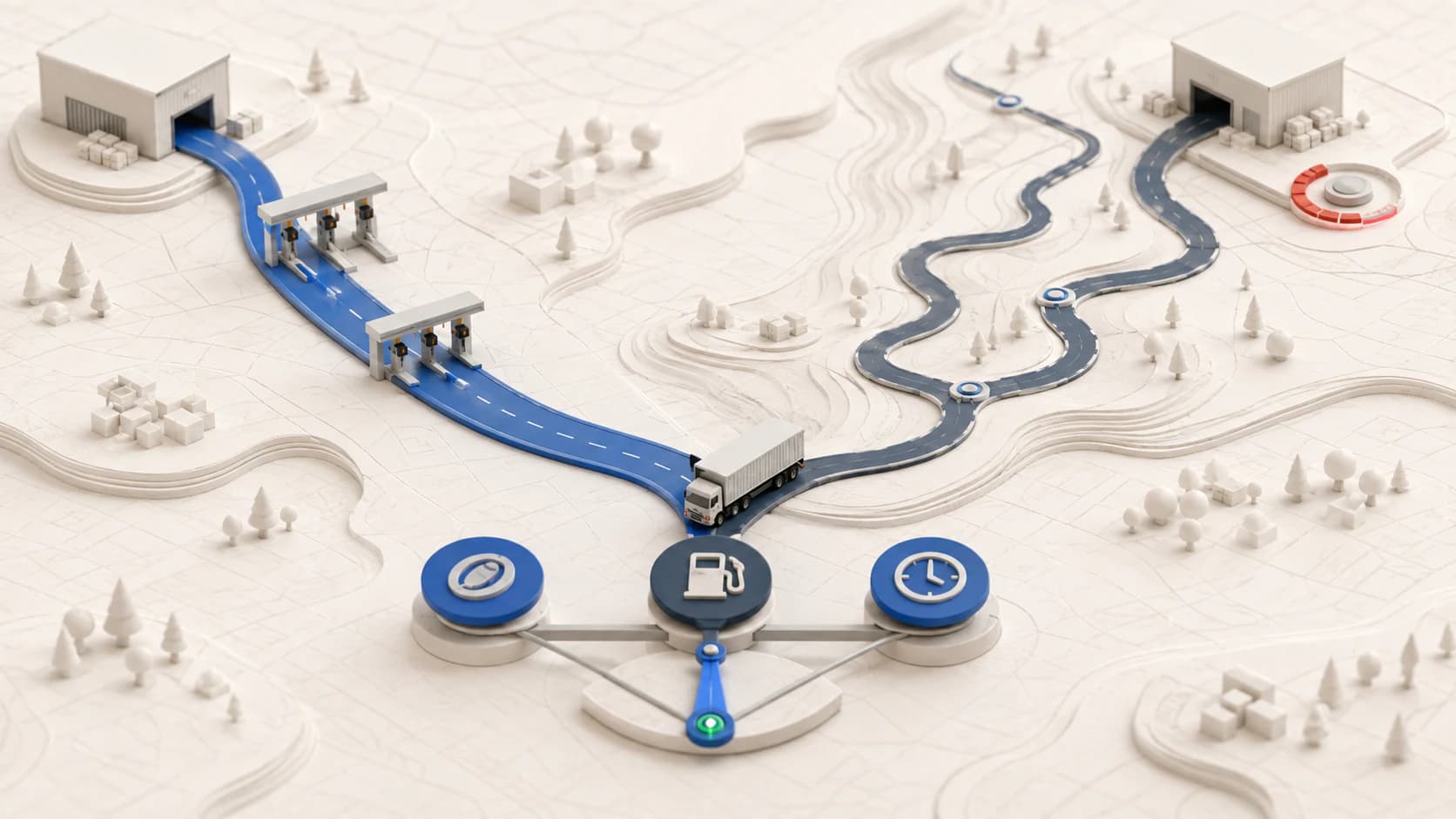
In the field this decision is usually made out of habit — the driver knows one route, so that's the one they always take. Habit lands on the right answer sometimes, but the moment the delivery window changes or fuel prices move, that same habit lands on the wrong side and nobody notices.
A toll-free route looks cheap — but only when you look at the toll charge alone. There's no gate fee on a toll-free road, but distance and time are usually longer, which means more fuel and more driver hours. The gap can be small, or it can be a meaningful share of the trip's cost.
The right decision weighs three lines together: the toll charge, the fuel difference, the time difference. A decision made without comparing all three in total isn't a route choice — it's habit.
This decision is usually made out of habit — the driver knows one route, so that's the one they always take. The moment the delivery window changes or fuel prices move, that same habit lands on the wrong side and nobody notices.
How do the three cost lines balance against each other?
To put the toll line in from the tariff rather than from memory, see the truck toll rates page: which class heavy vehicles fall into, and the current amount for each bridge.
The gap between the motorway and a toll-free road can't be reduced to a single number; three lines pull in opposite directions, and which one dominates depends on the job, the distance, and that day's conditions.
| Line item | Motorway | Toll-free road |
|---|---|---|
| Toll charge | Applies, varies by vehicle class | None |
| Distance and time | Usually shorter | Usually longer |
| Fuel consumption | Can be lower overall due to shorter time | Can be higher due to longer time |
| Driver hours | Fewer | More |
The motorway shortens time but adds a toll charge. The toll-free road removes the toll but stretches the time. Both are internally consistent choices; the problem is assuming one is "always right" without comparing the two.
That assumption can be wrong in either direction. A company that says "the motorway is always faster, so always use it" pays an unnecessary toll charge on short jobs with a wide delivery window. A company that says "avoiding tolls always raises margin" runs into a late-delivery risk on tight-window jobs without noticing the time it lost.
Which job calls for which route?
To record the decision trip by trip, download the freight tracking Excel template. Fuel and tolls stay in separate columns, so which choice works out cheaper on which lane is something you read off the table instead of estimating.
Three variables set the decision: how wide the delivery window is, how tight the margin is, how long the distance is. These can pull in different directions; the two examples below show the extremes, and the wide middle ground between them is covered in the next section.
On a job with a tight delivery window, the time advantage stands out. If the customer expects delivery at a specific hour, the delay risk on a toll-free road can cost more than the toll savings — a late-delivery penalty or a lost customer is worth far more than a few gate charges.
On a job with a wide delivery window and a tight margin, toll savings flow straight into the margin. If the distance is short, the time difference stays small too — in that case a toll-free road can be a reasonable choice, especially in a competitive bid where every line matters.
Most jobs fall between these two extremes and don't give a clean answer — a medium distance, a moderately wide delivery window. In those cases, no single rule decides it; you have to look at the trip-specific total of all three lines. The same route can produce a different answer on a different day, with a different vehicle.
Vehicle type affects the decision too. A heavy vehicle burns more fuel than the motorway on a toll-free road's gradients and junctions; that difference may be less pronounced for a lighter vehicle. The same route decision doesn't produce the same result for every vehicle.
If a fleet runs mixed vehicle types, one "correct route" rule for a given route may not fit every vehicle on it — the decision can depend on which vehicle is running the trip, not only on the route itself.
Season and traffic density factor in as well. Toll-free roads through tourist areas can get congested in summer, and a route that looks "shorter" can end up taking longer than the motorway. A fixed assumption can't catch that seasonal shift — what was the right call last year can turn out wrong on the same route this year.
How does the odds of a return load affect the decision?
Route choice affects more than the outbound trip — it affects the odds of a return load too. A motorway-heavy route is usually a busier corridor, and the odds of finding a return load can be higher along it.
If no return load turns up, empty-kilometre cost kicks in, and that cost spreads across the whole round trip regardless of which route was chosen. The route decision should factor in the odds of a return load, not just the outbound trip.
This is a line a decision based on the toll charge alone tends to miss. A trip that saved on tolls by taking the toll-free road outbound can have those savings wiped out by the fuel cost of an empty return. Route choice and the search for a return load aren't independent decisions.
See the motorway-versus-alternative difference weighed with fuel and time. A real comparison, not a guess.
Try it with your own lanesShould this be decided per trip or per route?
Both are needed, but for different purposes. Setting a route-level default speeds things up — for a frequently run route, "use this route" can be decided ahead of time.
But applying that default unquestioned on every trip is risky. That trip's delivery window may be tighter than usual, or traffic that day may be different. A fixed route decision is a starting point, not the final call for every trip.
A practical approach is to set a route-level default but re-check it at quoting time. The check costs little — if distance and toll are already being calculated for the quote, comparing the motorway against the alternative at the same time adds no extra work; both calculations draw on the same inputs anyway.
Seferi Route Service runs this comparison automatically for every trip: the difference between the motorway and an alternative route is weighed together with fuel and time, and every gate on the route is priced individually. We covered how the gate-by-gate calculation is built in how are toll charges calculated.
The result flows through to the financial side too: the right route decision directly lowers trip cost by avoiding unnecessary toll or fuel spend — and that reduction isn't limited to one trip, it repeats on every trip run on the same route.
See the motorway-versus-alternative difference on your own routes.
Try 14 days freeFrequently asked questions
Is the motorway always more expensive?
No. Looking at the toll charge alone, the motorway looks more expensive, but total cost includes the toll, fuel, and time together. The time the motorway saves usually means fewer driver hours and sometimes lower fuel use — savings that can partly or fully offset the toll charge.
Which jobs make more sense on a toll-free road?
When the delivery window is wide, the margin is tight, and the distance is short, the time disadvantage of a toll-free road can matter little while the toll savings go straight into the margin. When the delivery window is tight or the distance is long, the risk of losing time outweighs the toll savings.
Should this decision be made per trip or per route?
Both, but for different purposes. A route-level decision sets a general default; a trip-level decision accounts for that specific trip's delivery window, the value of the load, and that day's traffic. Applying a fixed route decision unquestioned every time misses those changing conditions.
Sources and references
- Motorway and bridge toll charges — General Directorate of Highways
- Inter-city distance table — General Directorate of Highways
This article is for general information; consult the relevant authority or your accountant for binding interpretation.